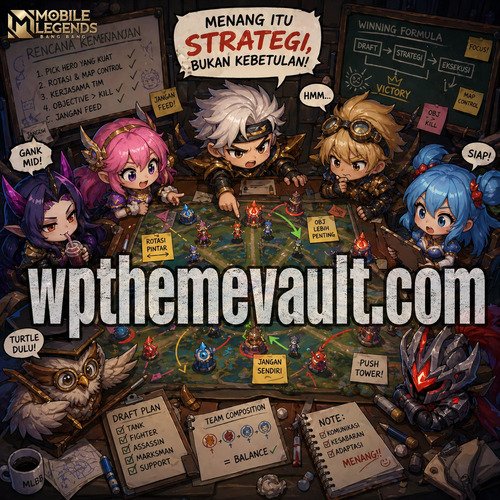
wpthemevault.com – Mobile Legends continues to dominate the mobile gaming landscape thanks to its exciting battles, competitive environment, and accessible gameplay. Millions of players enter the Land of Dawn every day with the goal of improving their skills, climbing the ranked ladder, and achieving victory with their teammates. Although the controls are relatively simple compared to PC-based MOBA titles, the strategic depth of Mobile Legends is much greater than many newcomers initially expect.
Winning consistently requires more than selecting a powerful hero or achieving a high number of eliminations. Players must understand map control, objective prioritization, hero matchups, team synergy, resource management, and decision-making under pressure. Every action performed during a match can either strengthen or weaken a team’s chances of success.
Many players become stuck in the same rank because they focus only on mechanical skills while neglecting the strategic elements that influence long-term performance. Understanding when to fight, when to retreat, when to push lanes, and when to secure objectives can often be more important than individual combat ability.
Developing a complete understanding of Mobile Legends allows players to contribute effectively regardless of their preferred role. Whether playing as a Tank, Mage, Marksman, Assassin, Fighter, or Support, mastering the game’s core principles creates opportunities to outperform opponents and help the team achieve victory.
Building Strong Foundations Through Game Knowledge
Every successful Mobile Legends player begins with a solid understanding of the game’s core systems. These fundamentals provide the framework upon which advanced strategies are built.
Many inexperienced players mistakenly believe that accumulating kills is the primary objective of the game. While eliminations can provide advantages, the ultimate goal is to destroy the enemy’s base.
A player may finish a match with an impressive kill count and still lose because the team failed to secure important objectives. Turrets, the Turtle, and the Lord often contribute more directly to victory than individual eliminations.
Turrets create territorial control and open pathways toward the enemy base. Every destroyed turret weakens the opposing team’s defensive structure and increases map pressure. Players who consistently focus on objectives rather than personal statistics tend to achieve better long-term results.
The Turtle provides valuable experience and gold that help accelerate team progression. Securing multiple Turtles can create significant economic advantages that become increasingly noticeable as the match progresses.
The Lord serves as one of the most influential objectives during the late game. Teams that successfully secure the Lord gain additional pushing power and force opponents to divide their attention between defending structures and contesting map control.
Understanding the relationship between objectives and victory helps players make smarter decisions throughout every stage of a match.
Learning the Importance of Resource Management
Gold and experience are the primary resources that determine hero strength. Efficient resource collection allows players to reach power spikes faster and gain advantages over opponents.
Minion waves represent a consistent source of income. Missing waves or abandoning lanes unnecessarily can create economic disadvantages that become difficult to overcome later. Players should always be aware of opportunities to collect resources while maintaining map presence.
Jungle camps also provide valuable rewards. Proper jungle management helps accelerate hero development and contributes to overall team strength. Efficient farming routes maximize resource acquisition while minimizing wasted movement.
Resource management extends beyond individual farming. Players must also understand when to share resources, rotate for objectives, and support teammates. A team that distributes resources effectively often performs better than one that concentrates everything on a single player.
Maintaining economic efficiency throughout the match creates stronger item progression and increases overall combat effectiveness.
Developing Effective Map Awareness
The minimap is one of the most important tools available to players. Constantly monitoring it provides valuable information about enemy positions, ally movements, and objective opportunities.
Many avoidable deaths occur because players focus exclusively on their immediate surroundings and ignore broader battlefield developments. By frequently checking the minimap, players can identify incoming threats and respond appropriately.
Map awareness also improves offensive decision-making. Observing enemy locations can reveal opportunities for ambushes, objective control, or coordinated pushes. Players who understand the flow of information often gain significant strategic advantages.
Developing strong map awareness requires practice and discipline. Over time, regularly checking the minimap becomes a natural habit that significantly improves overall gameplay performance.
Mastering Hero Roles and Team Responsibilities
Each role in Mobile Legends fulfills a unique purpose. Understanding these responsibilities enables players to contribute effectively regardless of their preferred hero selection.
Tank heroes are responsible for creating opportunities and protecting vulnerable teammates. Their durability allows them to absorb damage while controlling enemy movement through crowd-control abilities.
A strong Tank understands positioning better than almost any other role. Standing in the correct location can prevent enemy assassins from reaching key allies and create favorable engagement opportunities.
Initiation timing is another critical skill. Engaging too early may leave teammates unable to follow up, while engaging too late can allow enemies to dictate the pace of the battle. Effective Tanks recognize the ideal moments to begin team fights and create advantages.
Vision control is equally important. By scouting key areas and providing information, Tanks help the team make informed decisions while reducing the risk of unexpected ambushes.
The best Tank players act as strategic leaders who guide team movement and establish battlefield control.
Becoming a Reliable Marksman
Marksmen are often responsible for delivering the highest sustained damage during the late game. Their ability to eliminate objectives and enemy heroes makes them essential components of most team compositions.
The early game can be challenging for Marksman players because many heroes in this role possess limited defensive capabilities. Surviving the laning phase while collecting resources is therefore a major priority.
Farm efficiency plays a crucial role in Marksman development. Every minion wave, jungle camp, and objective contributes to faster item progression and stronger combat performance.
Positioning becomes increasingly important during team fights. Marksmen must remain protected while maintaining consistent damage output. Moving too aggressively can result in instant elimination, while excessive caution may reduce overall effectiveness.
Experienced Marksman players understand how to balance safety and aggression while maximizing their contribution to team success.
Utilizing Mages for Control and Burst Damage
Mages offer powerful abilities capable of influencing battles through burst damage, crowd control, and area denial.
Most Mage heroes excel at clearing minion waves quickly, allowing them to rotate efficiently between lanes. These rotations create opportunities to support teammates, secure objectives, and pressure opponents.
Ability accuracy often determines Mage effectiveness. Landing crucial crowd-control abilities can completely alter the outcome of engagements. Players who consistently execute skill combinations become valuable assets to their teams.
Positioning remains critical because many Mages lack strong defensive tools. Maintaining a safe distance while delivering consistent impact requires awareness and anticipation.
Successful Mage players combine mechanical precision with strategic decision-making to control the pace of the match.
Dominating the Jungle Role
The Jungler serves as one of the most influential players on the team. Responsible for farming neutral camps, securing objectives, and creating pressure across the map, this role demands strong decision-making and adaptability.
Efficient pathing allows Junglers to maximize resource acquisition while remaining available for ganks and objective contests. Every movement should contribute toward a larger strategic goal.
Objective control is a defining characteristic of effective Junglers. Proper timing and execution when securing the Turtle or Lord can significantly influence match momentum.
Successful Junglers also understand risk management. Aggressive plays can create advantages, but unnecessary risks often result in setbacks that benefit the opposing team.
Balancing farming, aggression, and objective control is essential for long-term success in this demanding role.
Once players master the fundamentals, advanced strategies become increasingly important. Higher-ranked matches often reward teams that execute superior tactical decisions.
Creating Strong Team Compositions
Drafting is the first strategic challenge encountered in every match. Building a balanced composition increases the likelihood of success before the game even begins.
An effective lineup typically includes frontline durability, reliable damage sources, crowd control, and objective-taking potential. Teams lacking one of these components may struggle against well-rounded opponents.
Understanding hero synergy can also create powerful advantages. Certain heroes complement each other’s abilities and create devastating combinations during team fights.
Counter-picking further enhances drafting effectiveness. Selecting heroes capable of limiting enemy strengths can significantly reduce their impact throughout the match.
Players who understand drafting principles often gain advantages before entering the battlefield.
Controlling the Mid Game
The mid game represents a transition period where strategic coordination becomes increasingly important. Teams begin contesting major objectives and grouping for larger engagements.
Lane pressure plays a significant role during this stage. Managing minion waves forces opponents to respond and creates opportunities elsewhere on the map.
Objective preparation becomes critical. Teams should establish vision, secure favorable positioning, and coordinate movements before contesting important targets.
Communication greatly enhances mid-game performance. Even simple coordination can transform isolated actions into effective strategic plays.
Teams that maintain discipline and focus during the mid game often build advantages that carry into the later stages of the match.
Executing Effective Team Fights
Team fights frequently determine match outcomes, particularly during the late game. Understanding engagement principles improves both individual and collective performance.
Target selection is one of the most important factors. Eliminating high-priority threats such as enemy damage dealers can significantly reduce opposing combat effectiveness.
Positioning remains equally important. Frontline heroes should absorb pressure while protecting vulnerable allies. Damage dealers must remain safe while maximizing output.
Cooldown management also influences engagement success. Wasting critical abilities before major fights can leave teams vulnerable during decisive moments.
Patience often proves more valuable than aggression. Waiting for favorable opportunities generally produces better results than forcing unnecessary engagements.
Successful teams approach every fight with a clear understanding of their objectives and responsibilities.
Maintaining a Winning Mentality
Mechanical skill and game knowledge are important, but mental discipline often determines long-term improvement.
Frustration can lead to poor decisions, unnecessary risks, and communication breakdowns. Maintaining composure allows players to evaluate situations objectively and respond effectively.
Adaptability is another valuable trait. Every match presents unique circumstances that require flexible thinking and strategic adjustments.
Learning from mistakes accelerates growth. Rather than focusing on blame, successful players analyze their decisions and identify opportunities for improvement.
Consistency ultimately separates average players from exceptional competitors. A disciplined mindset enables steady progress regardless of temporary setbacks or difficult matches.
Adapting to Meta Changes
Mobile Legends frequently receives updates that alter hero balance, item effectiveness, and gameplay dynamics. Players who adapt quickly gain advantages over those who rely on outdated strategies.
Studying patch notes helps players understand shifting priorities and emerging trends. Certain heroes may become stronger or weaker depending on recent adjustments.
Flexibility is especially valuable in a constantly evolving environment. Expanding hero pools and learning multiple roles improves adaptability and increases strategic options.
The most successful players embrace change rather than resist it. By remaining open to new strategies and approaches, they continue improving despite evolving competitive conditions.
Conclusion Mobile Legends Gameplay Guide: Essential Strategies for Every Stage of the Match
Mobile Legends is a game that rewards knowledge, teamwork, adaptability, and consistent practice. While individual skill can influence certain situations, long-term success depends on understanding the broader strategic elements that define the game.
Players who focus on objectives, manage resources effectively, maintain strong map awareness, and fulfill their role responsibilities contribute significantly more to team success. Advanced concepts such as drafting, team fight execution, and mid-game coordination further separate skilled competitors from average players.
Improvement is a continuous process. Every match provides opportunities to refine decision-making, strengthen mechanics, and develop a deeper understanding of the game’s complexities. By embracing both victories and defeats as learning experiences, players can steadily enhance their abilities and achieve greater success.
Ultimately, Mobile Legends is not simply about defeating opponents—it is about mastering strategy, working effectively with teammates, and making intelligent decisions under pressure. Those who dedicate themselves to learning these principles will find themselves climbing the ranks, winning more matches, and enjoying a richer competitive experience in the Land of Dawn.