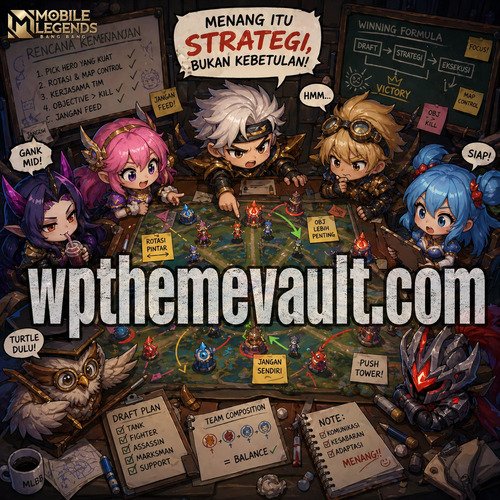
wpthemevault.com – Mobile Legends: Bang Bang Mobile Legends: Bang Bang is widely known for its fast-paced 5v5 battles, but beneath the surface of quick fights and flashy mechanics lies a deeply strategic system built on map control, timing, and decision-making. Many players struggle in ranked not because they lack mechanical ability, but because they treat every match as a series of isolated fights instead of a structured macro game.
To consistently climb, especially in solo queue, players must learn how to influence games without relying on teammates to always coordinate perfectly. This means understanding meta dynamics, adapting to unpredictable situations, and maintaining clarity in chaotic environments. The strongest players are not those who always win lane, but those who always know what the next correct decision is.
Understanding the Meta and Draft Philosophy
Every season in Mobile Legends: Bang Bang Mobile Legends: Bang Bang brings changes in hero strength, item efficiency, and overall gameplay tempo. The meta determines which heroes are most effective based on current balance, map changes, and common strategies in ranked play.
Understanding the meta is not just about picking overpowered heroes. It is about understanding why certain heroes are strong. Some dominate because of early game pressure, others because of scaling potential, and some because of utility that fits into almost any team composition. Players who understand this distinction can adapt even when their favorite hero is not strong in the current patch.
Role efficiency also matters. A strong hero in the wrong role or used incorrectly can still perform poorly. Meta awareness helps players choose heroes that not only fit the patch but also fit their personal playstyle and team needs.
Draft Strategy and Team Composition Balance
Drafting is often overlooked in solo queue, but it heavily influences match outcomes. A balanced team composition usually includes frontline durability, damage output, crowd control, and objective control. Without balance, even strong individual players struggle to convert advantages into wins.
For example, a team without a tank may struggle to initiate fights, while a team without damage may fail to finish objectives. Understanding these gaps during hero selection allows players to adjust their picks and improve overall team synergy.
Even in solo queue, thinking about draft balance increases win probability. Instead of focusing only on personal comfort picks, experienced players consider how their hero fits into the overall structure of the team.
Counter Strategy and Adaptive Picks
Counter-picking is a powerful tool in ranked games. Choosing heroes that naturally perform well against enemy compositions can significantly reduce difficulty in lane and team fights. However, counter strategy is not just about lane dominance—it is about limiting enemy impact across the entire map.
A good counter pick can force enemies into defensive playstyles, reduce their farming efficiency, or prevent them from executing their win condition. However, overcommitting to counter picks without understanding your own hero limits can backfire.
Adaptability is key. The best players are not those who always counter enemies perfectly, but those who can adjust their playstyle regardless of matchup difficulty.
Solo Queue Strategy: Playing Without Perfect Team Coordination
Solo queue in Mobile Legends: Bang Bang Mobile Legends: Bang Bang requires a different mindset compared to coordinated team play. Since communication is often limited, players must rely on personal map awareness and decision-making.
Self-reliance does not mean ignoring teammates—it means being prepared for inconsistent behavior. A strong solo queue player always checks minimap information, tracks objectives, and anticipates what teammates might do, even if they do not communicate it.
Map responsibility becomes personal. If no one rotates, you rotate. If no one checks objectives, you prepare vision. This proactive mindset reduces chaos and creates structure within unpredictable matches.
Risk Control and Decision Filtering
One of the biggest differences between average and high-ranked solo queue players is how they evaluate risk. In solo queue, not every fight is worth taking, especially when coordination is unreliable.
Decision filtering means constantly asking whether an action increases or decreases your chances of winning the game. Chasing kills, overextending lanes, or forcing objectives without backup often leads to unnecessary losses.
Instead of reacting emotionally to enemy movements, strong players filter decisions through logic: map state, team positioning, and objective timing. This reduces mistakes and improves consistency across matches.
Carry Potential and Win Condition Focus
Every game has a win condition, even in solo queue. Sometimes it is a fed marksman, sometimes it is split push pressure, and sometimes it is simply outlasting the enemy team into late game scaling.
Understanding win conditions allows players to focus their efforts effectively. If you are the strongest player on your team, your goal becomes maximizing impact. If another teammate is ahead, your goal becomes enabling them instead of competing for resources.
This shift in mindset transforms chaotic solo queue matches into structured opportunities for control and influence.
Advanced Game Control: Tempo, Objectives, and Mental Stability
Tempo refers to how fast or slow the game is played. Controlling tempo in Mobile Legends: Bang Bang Mobile Legends: Bang Bang allows players to dictate when fights happen and when farming is prioritized.
Fast tempo involves constant fighting, rotations, and objective pressure. Slow tempo focuses on scaling, wave control, and defensive positioning. Understanding which tempo benefits your team is crucial for making correct decisions.
Players who understand tempo can slow down aggressive enemies or accelerate games when their team has early strength. This control over pacing is one of the highest-level strategic skills.
Objective Discipline and Strategic Trading
Objectives are the backbone of winning games, but they must be approached strategically. Not every objective should be contested directly. Sometimes the correct play is to trade elsewhere on the map.
Strategic trading involves sacrificing one objective to gain another advantage, such as turrets, jungle control, or vision. This prevents unnecessary losses and keeps the game balanced even in difficult situations.
Teams that understand objective discipline tend to win more consistently because they avoid emotional decisions and focus on long-term value.
Mental Stability and Performance Consistency
Mental stability is one of the most underrated aspects of ranked success. Many players lose games not due to lack of skill, but due to frustration, impatience, or overconfidence.
In solo queue especially, emotional control is essential. Teammates will make mistakes, enemies will snowball, and games will feel unfair at times. However, reacting emotionally usually worsens outcomes rather than improving them.
Stable players focus on consistency. They treat every match as a separate problem to solve rather than a reflection of previous games. This mindset reduces tilt and improves long-term performance.
Learning Through Patterns, Not Random Experience
Improvement in Mobile Legends: Bang Bang Mobile Legends: Bang Bang comes from recognizing patterns rather than just playing more games. Every loss contains information about positioning mistakes, timing errors, or decision-making flaws.
Players who actively analyze their mistakes improve much faster than those who simply queue repeatedly. Recognizing repeated errors allows for targeted improvement rather than random learning.
This structured learning approach is what separates plateaued players from consistently climbing ones.
Consistency Over Highlight Plays
Many players focus on making flashy plays, but ranked success is built on consistency. Safe, correct decisions repeated over time produce more wins than occasional high-risk plays.
Consistency means avoiding unnecessary deaths, maintaining steady farm, and making objective-focused decisions. Even if a player never gets MVP, consistent performance leads to higher rank progression.
Over time, reliability becomes more valuable than occasional brilliance.
Long-Term Rank Progression Mindset
Climbing is not a short sprint—it is a long process of refinement. Each game contributes to skill development, whether it is a win or loss. The key is maintaining focus on improvement rather than short-term results.
Players who focus on learning instead of frustration naturally adapt faster, improve decision-making, and climb steadily. This mindset is the foundation of long-term success in ranked environments.
Conclusion Solo Queue Survival Guide: Strategy, Communication, and Meta Mastery in Mobile Legends
Mobile Legends: Bang Bang Mobile Legends: Bang Bang is ultimately a game of structure, adaptation, and mental discipline. Success in solo queue depends not only on mechanical ability but also on understanding meta trends, controlling tempo, making smart decisions, and maintaining emotional stability.
Players who develop awareness of draft strategy, solo queue responsibility, and objective discipline will consistently outperform those who rely solely on mechanics. In the end, climbing ranked is not about playing harder—it is about playing smarter, staying consistent, and making every decision contribute toward long-term victory.