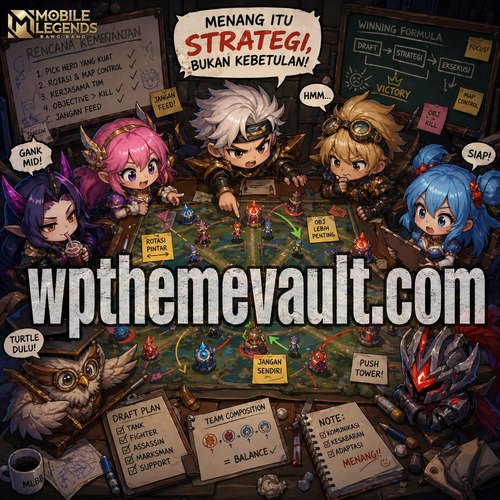
Understanding Bouncing Attacks and Building Safer Combat Habits
wpthemevault.com – Mobile Legends: Bang Bang is a game where positioning often determines the difference between a successful teamfight and a disastrous defeat. Many players concentrate on the amount of damage an enemy can deal to a single target, but another important factor is how that damage can travel between multiple heroes. Certain abilities and attack patterns can hit one target before bouncing, spreading, or chaining toward another nearby opponent. These mechanics make ordinary team formations potentially dangerous because teammates who stand too close together may allow one enemy ability to affect several heroes in quick succession. Understanding how chained attacks function helps players avoid unnecessary damage while maintaining enough proximity to support one another.
The first step toward countering these attacks is recognizing their conditions. Some bouncing abilities prioritize nearby units, while others follow a predetermined sequence or interact with targets within a specific radius. Their effectiveness may depend on the distance between heroes, the presence of minions, or the number of available targets. Players should observe what happens after an enemy lands a successful attack instead of immediately assuming that the damage will stop at the first target. If a projectile continues toward nearby allies, the team needs to reconsider its positioning. A formation that works well against a single-target assassin may be much less effective against an enemy who can distribute damage across a clustered group.
However, spreading out does not mean every player should abandon the team. Mobile Legends rewards coordination, and isolated teammates can become easy targets for opponents with strong mobility or reliable crowd control. The objective is to create enough space to reduce the effectiveness of chained attacks while preserving useful defensive relationships. A marksman might stand behind the frontline with a clear escape route, while a mage occupies a different angle and the roamer remains close enough to protect either target. This arrangement gives the enemy fewer opportunities to hit several heroes with one ability without making the team completely disconnected.
Players should also distinguish between attacks that genuinely bounce and abilities that merely deal area damage. An area attack usually affects targets within a defined region, whereas a bouncing effect may travel from one unit to another. That difference changes the correct response. Moving away from a marked area may prevent an area attack from connecting, but a bouncing projectile may still reach another hero if the team remains clustered. Learning the visual indicators, travel patterns, and target-selection rules of enemy abilities is therefore more valuable than reacting to every attack in the same way. Once the team understands the mechanic, it can make deliberate positioning decisions instead of repeatedly losing health through preventable mistakes.
Maintaining Distance Without Sacrificing Team Coordination
Spacing is one of the most important defensive habits against enemies who can spread damage between multiple targets. When teammates stand almost on top of one another, a single successful attack may create a chain that forces several players to retreat simultaneously. This can weaken the team’s damage output, interrupt its objective setup, and leave its frontline without enough health to initiate a fight. Maintaining reasonable distance reduces the chance that one ability will affect everyone at once, although the exact spacing required depends on the enemy’s range and the behavior of the ability involved.
A useful approach is to imagine the team occupying several connected positions rather than a single compact cluster. The tank or fighter can occupy the forward area, the mage can stand at a separate angle, and the marksman can remain behind a safe line of retreat. The roamer should position according to the immediate threat, protecting vulnerable allies without standing so close that one bouncing attack reaches several teammates. This arrangement does not require exact measurements or rigid formations. Instead, players should continually adjust their positions as the battle changes. If the enemy moves toward the marksman, the frontline can shift to block the approach while the mage creates additional space on the opposite side.
Spacing is especially important around jungle entrances and narrow paths. These locations naturally limit movement and make it easier for opponents to threaten several heroes simultaneously. When approaching a Turtle or Lord fight, avoid sending the entire team through the same narrow entrance if another safe route is available. One teammate can check a nearby approach while the rest maintain enough distance to respond if the enemy begins an engagement. At the same time, players must avoid wandering so far away that they cannot contribute when the fight begins. A separated damage dealer who cannot reach the objective or help a teammate may provide less value than a carefully positioned player who stays within a useful distance.
The minimap can help the team anticipate these situations. If several opponents disappear while your teammates are grouped near a jungle entrance, consider whether the enemy may be preparing to attack the entire formation. Moving into a more open area, waiting for additional information, or approaching from another direction can reduce the risk. During lane rotations, players should also avoid following directly behind an ally when the enemy has already demonstrated a reliable bouncing ability. A slightly different route may preserve travel efficiency while reducing the chance that both players become vulnerable at the same time. Good spacing is not about remaining permanently far apart; it is about recognizing when proximity creates more danger than benefit.
Choosing Heroes and Equipment for More Reliable Survival
Hero selection can influence how comfortably a team handles bouncing attacks. Mobile heroes may reposition quickly after the first target is hit, while durable fighters and tanks can absorb pressure without immediately forcing the entire formation to retreat. Heroes with reliable crowd control may also interrupt an opponent before the enemy can use another ability. Nevertheless, mobility and durability should not be treated as universal solutions. A dash is useful only when it creates meaningful distance or escapes the attack’s path, and a tank who repeatedly absorbs damage without controlling the fight may leave the rest of the team exposed.
When choosing a hero, consider the team’s overall needs rather than selecting a character solely because it can survive one dangerous attack. A composition still requires reliable damage, wave clear, objective control, and a way to protect vulnerable teammates. If the enemy depends heavily on close-range chained abilities, a lineup with flexible positioning and effective disengagement may be helpful. A roamer who can slow an approaching enemy, a mage who can control an entrance, and a marksman who can attack from a safe angle can work together to reduce the opponent’s opportunities. The key is to create several defensive options instead of relying on one hero to solve every problem.
Equipment choices should follow the actual damage pattern. If the enemy’s chained attacks primarily deal physical damage, suitable physical defense may improve survival. If the damage is primarily magical, magic defense may be more useful. Health can also help against mixed sources of damage, while certain defensive effects may be valuable when they match the enemy’s burst pattern. Players should examine the enemy lineup, completed items, and observed damage before spending gold. Building an item merely because the opponent has a bouncing ability can be inefficient if the primary threat actually comes from another hero.
Defensive equipment is most effective when combined with better decisions. A marksman who buys extra defense but continues standing beside several teammates may still allow the enemy to damage the formation and force a retreat. Conversely, a player who positions intelligently can make defensive resources last longer and preserve more health for the next objective. Players should also consider whether an offensive item can shorten the time needed to eliminate the enemy responsible for the pressure. There is no universal build for every match, so itemization should reflect the specific heroes, damage types, and timing of the enemy’s power spikes. The strongest response combines suitable equipment, correct spacing, and coordinated movement rather than depending on any single defensive solution.
Turning Defensive Awareness Into Better Map Control and Teamfights
Minion waves can influence how players approach enemies whose attacks bounce between targets. Depending on the ability, nearby minions may provide additional targets, affect the path of a projectile, or have no meaningful effect at all. Players should learn the exact behavior of the relevant enemy skill instead of assuming that minions always protect heroes or always increase the danger. This knowledge can help determine when to clear a wave quickly, when to remain behind friendly minions, and when to move away from a crowded lane.
During the laning phase, avoid standing directly beside the minion wave if the opponent can use a successful attack to threaten both minions and heroes. Keeping a little distance from the wave may reduce the chance of being hit by a chain that begins with a nearby unit. However, standing too far away can make it difficult to collect gold and experience from minions. Players need to balance safe positioning with lane income. Watch the enemy’s ability usage, wait for dangerous skills to be spent when possible, and move forward to secure farm when the immediate threat is lower.
Wave management also determines whether a player can safely rotate. Before leaving a lane, consider the condition of the minion wave and whether the opponent can punish the absence. Clearing a wave may create time to assist another lane, contest an objective, or establish vision around a jungle entrance. Yet clearing it carelessly can expose a hero to repeated attacks if the enemy is waiting nearby. A better approach is to understand the opponent’s effective range, position near a safe escape route, and avoid trading health simply to eliminate the final few minions. Maintaining enough health for the next rotation is often more valuable than winning a small exchange that provides little lasting advantage.
When multiple allies gather to clear a wave, they should consider whether clustering creates an unnecessary opportunity for the enemy. A mage and marksman can often clear from separate positions, while the roamer monitors possible threats. If the opponent begins moving toward the lane, the team can retreat without forcing every player to cross the same narrow path. This becomes especially important when defending a damaged turret, where the structure may encourage teammates to stand close together. The team should defend the wave and protect the structure while remaining aware of how its formation interacts with the enemy’s abilities.
Minion management becomes even more valuable in the middle and late game. A team that pushes one lane before rotating can force opponents to respond to the wave, reducing the number of enemies available around a major objective. This does not guarantee a safe engagement, but it can improve the team’s map position. If the enemy must clear a large wave, your team may have more time to establish vision and choose its approach. Good lane management therefore supports the defensive plan indirectly: it creates better timings, safer routes, and more opportunities to engage on favorable terms.
Timing Crowd Control and Focus Fire Against the Main Threat
When an enemy can spread damage through a formation, the team should pay close attention to the source of that pressure. Repeatedly retreating after each attack may keep players alive temporarily, but it does not necessarily prevent the opponent from controlling the battlefield. If the enemy must approach a certain distance or remain exposed to use the ability effectively, crowd control and coordinated damage can punish that commitment. The team should identify the most dangerous ability, recognize the conditions required to use it, and decide whether to interrupt the enemy or disengage until the threat has passed.
Crowd control should be used with a clear purpose. Stunning an enemy before the first attack may prevent the entire chain, while using the same ability after the damage has already spread may provide little immediate defensive value. However, players should not automatically spend every control skill as soon as an opponent appears. If the enemy has another important ability available, holding crowd control for the correct moment may produce a better result. A roamer might wait until the enemy moves into range, while the mage prepares damage and the marksman maintains a safe firing angle. When the enemy commits, the team can respond together instead of using skills independently.
Focus fire also matters because an enemy who repeatedly applies pressure becomes more dangerous when allowed to operate freely. If that hero has limited durability, coordinated damage may remove the threat before it can use several abilities. If the opponent is protected by a tank or another defensive hero, attacking the frontline may be necessary until a safe opportunity appears. Chasing the enemy damage dealer through a dangerous jungle path is rarely worthwhile if it separates your team and creates an opportunity for the rest of the opponents to attack. Target selection must account for accessibility, survival, and the position of the other four enemies.
Communication can make these decisions more consistent. Even simple signals can tell teammates that a dangerous ability has been used, that the enemy’s main damage dealer is approaching, or that the team should disengage. Players do not need lengthy explanations during a fight. A clear ping and coordinated movement can be enough to prevent teammates from entering the same dangerous area. After the enemy uses its key ability, the team should quickly assess whether it has a temporary advantage. If the opponent’s threat is reduced, that may be the moment to secure a nearby objective, clear a wave, or establish better map control. The goal is to convert defensive awareness into a concrete advantage rather than simply surviving the encounter.
Applying the Strategy During Turtle, Lord, and Late-Game Sieges
Major objectives create some of the most difficult situations for teams facing bouncing attacks. The objective itself attracts players into a limited area, and the surrounding jungle often restricts their movement. If several teammates stand close together while attacking Turtle or Lord, an enemy may gain an opportunity to damage multiple heroes and disrupt the contest. A safer approach begins before the objective spawns or becomes the team’s immediate priority. Push the relevant lane, check nearby approaches, and position teammates so they can monitor separate angles without losing the ability to help one another.
During the objective attempt, the team should decide who will damage the monster, who will watch for enemy approaches, and who can contest an incoming opponent. These responsibilities may change depending on the composition and current match state. A jungler needs to preserve access to the objective and manage Retribution timing, while teammates should avoid making the jungler’s task harder by starting an unnecessary fight in a crowded position. If the enemy approaches with a dangerous chained ability, the team may temporarily pause damage and reposition. Continuing to attack without considering the incoming threat can cause the team to lose health, abandon the objective, or become vulnerable to a coordinated engage.
Sometimes the best response is to concede the objective and gain value elsewhere. If the enemy controls the entrances, your team has low health, or key defensive abilities are unavailable, contesting may create a greater risk than reward. Players can instead clear waves, defend a threatened turret, or push a different lane while the enemy spends time securing the monster. This decision requires an honest assessment of the current situation. A team should not abandon every objective simply because an opponent has a strong ability, but it should also avoid treating every contest as mandatory.
Late-game sieges require similar discipline. When attacking a turret, players often cluster behind a frontline or around a minion wave because they want to remain within range of the structure. That formation can become vulnerable if the enemy has a reliable way to chain damage across nearby heroes. Spread the damage dealers across safe angles, let durable teammates manage the forward position, and avoid standing in a narrow corridor when a wider approach is available. If the enemy successfully lands its main ability, retreat briefly rather than forcing the siege with a weakened formation. A short pause can preserve the team’s health and allow another wave to arrive.
Defending high ground also depends on knowing when to remain together and when to spread out. Teammates must stay close enough to protect the base, clear minions, and prevent an enemy from reaching the core, but they should avoid unnecessary clustering around a single entrance. Use structures, defensive abilities, and clear escape routes to make the opponent commit before exposing several heroes to danger. When the enemy’s ability is unavailable, the defenders may gain a brief opportunity to clear a wave or eliminate an approaching target. When the threat is ready, prioritize survival and structure defense over a low-value chase. Consistent decisions during these critical moments often matter more than winning an isolated exchange.
Conclusion How to Play Mobile Legends: Countering Bouncing Attacks and Preventing Damage From Spreading Across Your Team
Countering bouncing attacks in Mobile Legends requires more than buying defensive equipment or telling teammates to spread out. Players must understand how the enemy’s ability selects targets, recognize the conditions that allow damage to travel between heroes, and adjust their formation without sacrificing coordination. Better spacing reduces the number of teammates who can be affected by one attack, while appropriate hero selection and itemization improve the team’s ability to survive dangerous engagements. Lane management adds another layer of protection by creating safer rotations and preventing opponents from forcing fights at unfavorable times.
During teamfights, the most effective response combines awareness, controlled use of crowd control, and coordinated target selection. Players should recognize when the enemy has used its main ability and take advantage of the resulting opportunity without chasing into unsafe terrain. Around Turtle, Lord, and turrets, positioning should be planned before the fight begins, especially when narrow entrances encourage the team to cluster. Sometimes a temporary retreat or a decision to secure value elsewhere is better than forcing an unfavorable contest.
Ultimately, strong gameplay comes from adapting to the mechanics that actually threaten the team. Observe the enemy’s attack behavior, communicate important cooldowns, maintain useful spacing, and make decisions according to the current map situation. By preventing one successful attack from turning into several damaged teammates, a team can preserve its resources, defend important structures, and create better opportunities to win objectives and finish the match.