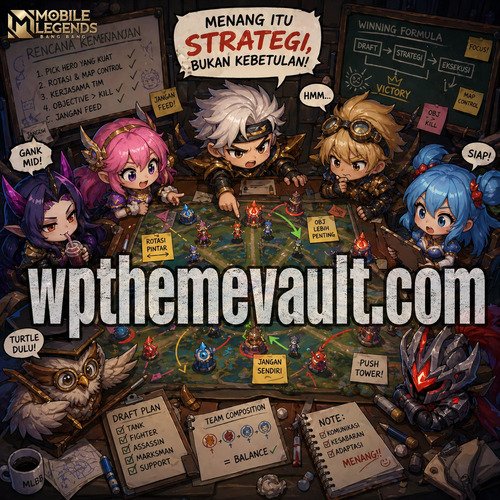
wpthemevault.com – Mobile Legends: Bang Bang is often perceived as a fast mobile game focused on reflexes and combat mechanics, but beneath its surface lies a deeply strategic system. Every hero in the game has a defined purpose, and every match is shaped by how well those purposes are executed. Winning consistently is not about relying on one strong hero or one lucky fight, but about understanding how heroes interact with each other, how they scale over time, and how decisions affect the entire flow of the game.
Each match follows a predictable structure, yet every situation feels different because player decisions constantly change the outcome. A hero’s strength is never absolute; it depends on timing, positioning, item progression, and teamwork. This is why experienced players focus less on raw mechanics and more on understanding the game at a strategic level.
To truly improve, a player must learn to see heroes not as isolated characters, but as roles within a larger system. Every movement, skill, and rotation contributes to one goal: controlling the match and securing victory.
Hero Roles and Their Core Strategic Identity
Every hero in Mobile Legends belongs to a specific role that defines how they should be played. These roles are not just labels, but frameworks that determine positioning, decision-making, and impact throughout the match.
Tank heroes are responsible for absorbing damage and initiating fights, but their importance goes far beyond durability. They control space, dictate enemy movement, and provide vision that allows the team to act safely.
A strong tank player understands timing better than aggression. Engaging too early can isolate the team, while engaging at the right moment can instantly win a fight. Tanks must constantly read enemy positioning and decide when their team is ready to follow up.
They also play a crucial role in vision control by checking bushes and scouting dangerous areas. This prevents ambushes and allows safer rotations around the map. Without tanks, teams often lack structure and become vulnerable to surprise attacks.
In many cases, tanks act as the “tempo controllers” of the match, deciding when the team can advance or when it must retreat and reset.
Marksmen as Scaling Damage Carries
Marksmen are the primary source of sustained damage, especially in the mid and late game. Their power scales heavily with items, making them extremely dangerous once they reach their core build.
However, marksmen are also highly fragile. This creates a constant requirement for careful positioning and awareness. Staying alive is more important than chasing kills or risky plays.
During the early game, marksmen focus on farming and building their items safely. Every minion wave and jungle resource contributes to their growth. Falling behind early can significantly reduce their effectiveness later.
In team fights, marksmen must stay behind their frontline and deal consistent damage without exposing themselves. A single positioning mistake can lead to instant elimination.
The best marksmen understand patience—they wait for safe openings instead of forcing aggressive plays.
Mages, Fighters, Assassins, and Supports as Specialized Impact Roles
Mages provide burst damage and area control, making them extremely effective in mid-game fights. Their abilities can change the outcome of battles instantly when used at the right moment.
Fighters are hybrid heroes that combine durability and damage. They can act as frontline fighters, side laners, or secondary damage dealers depending on team needs, making them highly flexible.
Assassins rely on timing, vision, and precision. Their job is to eliminate high-priority targets like marksmen or mages. However, success depends on patience—entering too early often results in failure.
Supports strengthen the entire team through healing, shields, crowd control, and utility effects. Even though their damage is low, their influence is extremely important in team survival and fight sustainability.
Game Phases and How Heroes Change Their Roles Over Time
Every Mobile Legends match evolves through stages. Each stage changes how heroes behave and what decisions matter most. Understanding this progression is essential for consistent performance.
The early game is focused on building resources and avoiding unnecessary risks. Gold and experience determine how quickly heroes reach their power spikes.
Small mistakes during this phase can have long-term consequences. Dying early or losing farm slows item progression and reduces impact in later fights.
Map awareness is extremely important because early ganks are common. Knowing enemy positions helps players stay safe and make better decisions.
Objectives like Turtle provide early advantages, but they should only be contested when conditions are favorable. Smart players prioritize stability over risky fights.
Mid Game: Rotation, Pressure, and Map Control
The mid game is where matches become more dynamic. Heroes begin to complete core items, and team fights become more frequent.
Rotations play a key role in this phase. Moving as a group allows teams to apply pressure across multiple lanes, secure objectives, and create numerical advantages.
Tower destruction becomes important because it expands map control and limits enemy movement. Teams that rotate efficiently can force opponents into defensive positions.
Communication and coordination are critical here. Teams that move together and synchronize their actions usually gain momentum and control the match.
Late Game: Precision, Discipline, and High-Pressure Execution
The late game is the most intense stage of Mobile Legends. Every decision matters because respawn times are long and objectives can decide the game instantly.
Team fights require perfect coordination. Tanks initiate, damage dealers follow up, and supports provide protection. Even small mistakes can lead to defeat.
Objectives like Lord become game-ending opportunities. Securing them creates massive pressure, while losing them can completely reverse the match.
At this stage, patience is the most powerful tool. Rushed decisions often result in losing control.
Becoming a strong Mobile Legends player is not about playing endlessly, but about learning intelligently and improving consistently.
Adaptive Itemization and Match Awareness
Item builds must change depending on the situation. Every match has different enemy compositions, requiring different responses.
Defensive items help survive burst damage, while offensive items increase damage potential. Knowing when to adapt is a key skill that separates average players from advanced ones.
Flexible itemization allows heroes to remain effective in any situation.
Map Awareness and Strategic Decision-Making
Map awareness is one of the most important skills in the game. Constantly checking the minimap provides critical information about enemy movements and potential threats.
Decision-making depends on this information. Knowing when to fight, rotate, or retreat helps maintain control of the game. Strong players rely on information rather than instinct alone.
Learning, Reflection, and Long-Term Growth
Every match provides lessons. Wins reinforce good habits, while losses reveal weaknesses that need improvement.
Watching skilled players, analyzing gameplay, and trying different heroes help expand understanding. Since the game evolves with updates, adaptation is always necessary. Players who consistently learn and adjust their mindset improve steadily over time.
Conclusion Mobile Legends Hero Mastery: Understanding Strategy, Roles, and Competitive Game Flow
Mobile Legends: Bang Bang is a strategic game built on teamwork, awareness, and decision-making. Every hero has a defined purpose, and success depends on how well that purpose is executed within the flow of the match.
From tanks that control engagements to marksmen that scale into late-game threats, every role contributes to victory in a unique way. Players who understand game phases, adapt to situations, and make intelligent decisions will always perform more consistently.
Ultimately, hero mastery is not a final achievement but an ongoing process. The deeper a player understands the game, the more clearly they see that victory is built from small decisions that connect into a larger strategy.