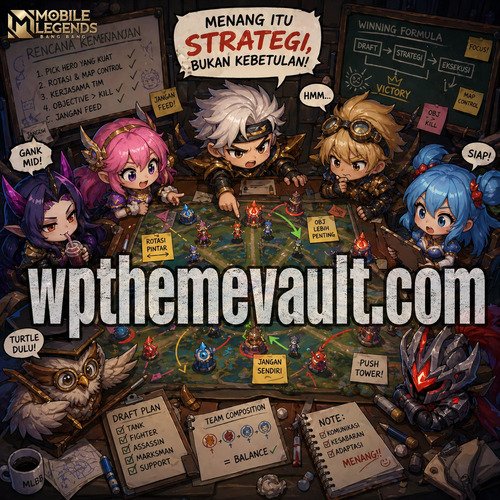
wpthemevault.com – Mobile Legends: Bang Bang rewards players who understand that victory is not simply about eliminating opponents but about mastering roles, reading the battlefield, and executing decisions with discipline. Every hero brings a different layer of complexity to the game, and climbing the ranked ladder requires more than mechanical skill alone. It demands awareness of timing, map control, team coordination, and the ability to adapt under pressure. As matches progress from early skirmishes to late-game standoffs, the importance of structured thinking becomes even more apparent, turning each hero choice into a strategic commitment rather than a casual preference.
Understanding Hero Identity and Combat Roles
Every hero in Mobile Legends exists within a structured ecosystem of roles, each designed to fulfill specific combat responsibilities. Understanding these roles is the first step toward consistent performance. A team without clear role execution often collapses under pressure, while a well-balanced composition can control fights even when behind in gold or kills. The interaction between roles defines how fights unfold, making role comprehension the foundation of advanced gameplay.
Tanks are more than just damage absorbers; they are the architects of teamfights. Their presence alone shapes how enemies position and react. A well-played tank dictates engagement timing, forcing opponents into defensive stances simply by threatening initiation. Whether absorbing turret shots during dives or leading rotations through dangerous terrain, tanks create the space necessary for damage dealers to function effectively.
What separates average tank players from impactful ones is patience and awareness. Initiating too early often leads to wasted engagements, while hesitation can cost critical opportunities. High-level tank play revolves around reading enemy cooldowns and positioning. When key enemy skills are unavailable, tanks step forward to engage, disrupting formations and creating chaos. Heroes with strong crowd control excel in this role because they can lock multiple targets simultaneously, turning fights instantly in their team’s favor.
Beyond fighting, tanks also control vision. Entering bushes first, scouting jungle paths, and protecting rotations are all subtle but essential contributions. Without a strong tank presence, even the most skilled damage dealers struggle to operate safely.
Damage Dealers: Marksmen and Assassins Compared
Damage dealers are the primary win condition in most matches, but their playstyles differ significantly between sustained and burst-oriented heroes. Marksmen provide consistent damage output that scales heavily into the late game, while assassins focus on eliminating priority targets quickly before escaping danger. Both roles require positioning discipline, but their approaches to fights differ fundamentally.
Marksmen thrive on distance and uptime. Their effectiveness increases the longer they remain alive during fights, continuously applying pressure from the backline. However, they are also the most vulnerable to dives, meaning positioning is everything. A slight misstep can result in immediate elimination, often changing the outcome of an entire fight. Strong marksmen players constantly reposition during fights, never staying static even when dealing damage.
Assassins, on the other hand, operate on timing windows. They wait for enemies to overextend or waste defensive skills before committing. Their success depends on precision rather than sustained presence. A well-timed entry can instantly remove a key target, shifting momentum. However, failure to secure a kill often leaves assassins exposed and vulnerable. This makes decision-making far more critical than mechanical execution alone.
Mages and Fighters as Hybrid Pressure Tools
Mages and fighters often serve as hybrid roles that blend damage, utility, and map pressure. Mages provide area control and burst damage, shaping fights through zoning and skill-based crowd control. Fighters contribute sustained pressure in side lanes while also being durable enough to participate in extended engagements. Together, they form the flexible core of many team compositions.
Mages excel in controlling space. Their abilities often dictate where enemies can or cannot move, especially in narrow areas like jungle entrances or objective zones. A well-placed ultimate can completely deny access to critical areas, forcing enemies into unfavorable positions. Fighters, meanwhile, apply consistent pressure in lanes and can transition into teamfights without losing effectiveness.
What makes these roles particularly valuable is their adaptability. They can function as secondary initiators, follow-up damage dealers, or even split-push threats depending on the situation. This flexibility allows teams to adjust strategies dynamically without changing core composition.
Macro Strategy and Battlefield Control
Winning consistently in Mobile Legends requires more than individual performance. Macro strategy—how a team moves, rotates, and controls objectives—often determines match outcomes long before final teamfights occur. Understanding macro play transforms the game from reactive skirmishes into structured map domination.
The early game is defined by efficiency and discipline. Each hero must follow a structured lane assignment that maximizes experience and gold distribution while minimizing unnecessary risk. Mismanaging early lanes often leads to cascading disadvantages that are difficult to recover from.
Tempo begins with wave control. Clearing minion waves quickly allows players to rotate and support teammates without losing resources. Mid-laners often act as the first rotational catalysts, influencing side lanes and jungle skirmishes. However, rotations must be calculated rather than impulsive. Abandoning a lane without proper wave management can result in turret loss, giving enemies long-term map control.
Successful early game play is about balance. Players must decide when to pressure and when to stabilize. Over-aggression leads to unnecessary deaths, while excessive passivity results in lost opportunities. Teams that master early tempo often dictate the entire flow of the match.
Objective Control and Map Pressure
As the game transitions into mid-stage, objectives become the primary focus. Turrets, jungle resources, and neutral objectives define map control and resource advantage. Teams that consistently secure these objectives gain both economic and positional superiority.
Objective control is not just about arriving first; it is about preparation. Clearing waves before rotating ensures that enemies are forced to respond defensively, reducing their ability to contest. Establishing vision around key areas also prevents surprise engagements. Without vision control, even stronger teams risk losing objectives due to unfavorable positioning.
Map pressure is created through simultaneous threats. While one side of the map is contested, pressure in another lane forces enemies to split attention. This creates openings for safe objective execution. High-level teams constantly rotate pressure points, preventing opponents from stabilizing.
Vision, Rotations, and Information Advantage
Information is one of the most powerful assets in Mobile Legends. Knowing enemy positions allows teams to make confident decisions without fear of ambush. Vision control is primarily achieved through map presence, bush checking, and controlled rotations.
Rotations are the backbone of macro play. Moving as a coordinated unit ensures numerical advantage during fights and reduces the risk of isolation. Proper rotations also allow teams to collapse quickly on exposed enemies or retreat safely when needed.
Information advantage dictates engagement decisions. Teams with superior vision can force fights on their terms, while those lacking information must play defensively. This difference often determines whether a match feels controlled or chaotic.
At higher levels of play, mechanical skill alone is no longer sufficient. Success depends on adaptation, prediction, and psychological awareness. Players must constantly adjust to enemy behavior, item builds, and shifting game states to maintain an edge.
Mechanical Execution and Skill Optimization
Mechanical execution remains the visible foundation of gameplay. Each hero has optimized skill sequences that maximize efficiency and damage output. Mastering these sequences allows players to respond quickly during chaotic fights without hesitation.
However, execution must be contextual. Using a perfect combo on the wrong target is still a mistake. High-level players combine mechanics with awareness, ensuring that every skill rotation has purpose. Movement also plays a critical role, as positioning determines both survivability and damage uptime.
Skill optimization extends beyond combos. Animation timing, canceling unnecessary delays, and chaining abilities smoothly all contribute to higher effectiveness. These small improvements often separate average players from consistently impactful ones.
Itemization and Counterplay Decisions
Itemization is a dynamic system that adapts to enemy composition and game flow. Sticking to fixed builds limits flexibility and often results in inefficiency. Understanding when to adjust items is essential for survival and damage optimization.
Defensive adjustments are necessary when facing burst-heavy compositions, while offensive penetration becomes crucial against tanky lineups. Hybrid builds often emerge when players need both survivability and damage contribution.
Counterplay also involves anticipating enemy builds. Recognizing when opponents are shifting toward defensive or offensive strategies allows players to adjust accordingly. Smart itemization often neutralizes enemy advantages before they fully develop.
Psychological Play and Endgame Discipline
The late game introduces psychological pressure that affects decision-making. One mistake can end the match due to high damage output and long respawn timers. Discipline becomes the defining factor in these moments.
Endgame play revolves around patience and coordination. Forcing unnecessary fights often leads to disaster, while controlled engagements maximize win probability. Teams must wait for clear advantages before committing fully.
Psychological awareness also involves reading opponent behavior. Predicting panic movements, overextensions, or hesitation can create decisive openings. Strong players remain calm under pressure, ensuring that decisions are based on logic rather than emotion.
Conclusion Climbing the Ranks in Mobile Legends: Hero Mastery and Strategic Play
Climbing the ranks in Mobile Legends requires more than mechanical talent; it demands structured thinking, adaptability, and deep understanding of both micro and macro gameplay. Every role contributes to a larger system where timing, positioning, and coordination determine success. From early game lane discipline to late-game psychological pressure, each stage of the match tests different aspects of player skill.
True mastery comes from combining these elements into a consistent approach. Players who understand roles, control the map effectively, and adapt to evolving situations will always outperform those who rely solely on mechanics. In the end, Mobile Legends is not just a game of heroes—it is a game of decisions, and those decisions define every victory.