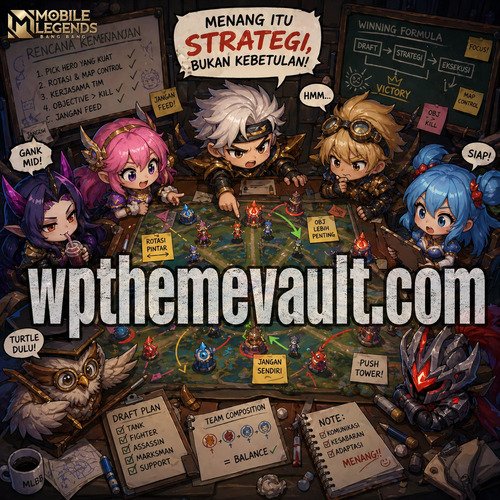
wpthemevault.com – Mobile Legends: Bang Bang is often introduced as a fast-paced multiplayer game where players select heroes, defeat opponents, destroy turrets, and eventually break the enemy base. While those mechanics are fundamental, improving beyond the beginner level requires a deeper understanding of what happens between major fights. A player can have strong mechanical skills and still struggle to win consistently if they arrive late to objectives, mismanage minion waves, ignore dangerous areas of the map, or take fights without considering what happens afterward. This is why macro gameplay becomes increasingly important as players gain experience.
Macro gameplay refers to the larger decisions that determine how a team uses the map, resources, timing, and pressure. It does not replace mechanical ability. Instead, it gives mechanical ability a purpose. A well-executed skill combination becomes more valuable when it is used during an important objective fight rather than in an isolated encounter that produces little progress. Likewise, a fast rotation is only useful when the destination and timing make sense.
Understanding macro does not mean predicting everything that will happen during a match. Mobile Legends is too dynamic for that. Instead, good macro comes from recognizing patterns, gathering information, and making decisions based on the most useful option available at that moment. Players who develop this habit can become more consistent even when their teammates, opponents, and match situations change from game to game.
Reading the Map and Creating Pressure
The minimap is one of the most valuable sources of information in Mobile Legends, yet it is easy to overlook while focusing on combat. Players who want to improve their overall gameplay should develop the habit of checking the map regularly rather than only looking at it when an objective appears. The positions of visible enemies, the location of allied heroes, the condition of lanes, and the movement of minion waves can reveal what is likely to happen next.
Suppose several enemy heroes disappear from the map at the same time. The disappearance itself is information. It does not prove that they are preparing an ambush, rotating toward an objective, or attacking a teammate, but it means the player should become more cautious. Continuing to push a lane deeply without checking the surrounding area can turn a safe situation into an easy opportunity for the opposing team.
The same principle applies when several enemy heroes appear on one side of the map. Their positions can create opportunities elsewhere. If multiple opponents are showing far away, another lane may temporarily become safer to pressure. A teammate may also have an opportunity to take a resource or clear a wave without immediate interference.
Map awareness is therefore more than simply seeing enemy icons. It is the process of turning available information into decisions. Players should ask themselves what the visible information means and what remains unknown. If an enemy jungler was recently seen on one side of the map, that can influence how aggressively a player approaches another area. If the enemy roamer has disappeared, fragile heroes should become more careful about entering narrow areas.
This habit becomes especially important when playing heroes that depend on positioning. Damage dealers often cannot afford to walk blindly into areas where enemy crowd control may be waiting. Frontline heroes may have more freedom to check dangerous spaces, but they still need to understand what threats could appear behind them. The more consistently a player reads the map, the less often they will be surprised by rotations that were actually predictable from the available information.
Controlling Bushes and Dangerous Areas
Bush control is another major part of Mobile Legends macro gameplay. Bushes provide opportunities for concealment, allowing heroes to approach enemies without being immediately visible. Because of this, the player who controls an important bush can influence how safely the opposing team moves through the map.
However, controlling a bush does not always mean standing inside it. Sometimes the better approach is simply to prevent the opponent from comfortably entering a particular area. A team that occupies important paths can force enemies to take longer routes or approach objectives from less favorable positions.
Players should be especially careful when entering areas that have not been checked recently. Walking directly into a bush without information can expose a hero to crowd control and burst damage. This becomes increasingly dangerous as the match progresses because heroes usually have more damage and stronger combinations later in the game.
Vision should therefore be treated as a resource. Knowing where enemies are allows players to move confidently. Not knowing where they are requires caution. This does not mean players should stop moving whenever an opponent disappears, but it does mean they should adjust their positioning according to the level of uncertainty.
Teams can also use controlled vision to prepare traps. If an enemy expects a certain route to be safe, a coordinated team may position itself nearby and wait for the opponent to enter. Successful ambushes often come from information advantages rather than raw mechanical superiority.
For individual players, the key lesson is simple: never assume an area is safe merely because nothing is visible. Information must be created and maintained. The more important the location, the more valuable that information becomes.
Turning Pressure Into Meaningful Progress
Pressure is frequently misunderstood as constant aggression. In reality, pressure means forcing the opposing team to respond to your actions. A pushed lane can create pressure because an enemy must clear it. A controlled jungle entrance can create pressure because the opposing team may hesitate to enter. A threat around an objective can create pressure because opponents must decide whether to contest or give ground.
Good pressure should eventually produce something useful. If a team spends a long time chasing opponents without gaining an objective, structure, resources, or map control, the pressure may not be accomplishing much. Players should therefore think about what they want their pressure to achieve.
For example, pushing a side lane before an objective can force an opponent to choose between defending the wave and joining the contest. This creates a strategic problem. If they remain in the side lane, their team may be weaker around the objective. If they leave the lane, the wave may damage their structure.
The value of pressure comes from creating these difficult choices.
Players should also recognize when pressure becomes excessive. A hero that pushes too far without support can become isolated. The opponent may allow the wave to advance and then collapse on the player. In such situations, the original pressure turns into a liability.
The best macro decisions often involve creating pressure while preserving an escape route. Players should know where their teammates are, where enemy threats could appear, and how quickly they can retreat if the situation changes.
Managing Timing, Resources, and Team Decisions
Tempo is the rhythm of a Mobile Legends match. Teams constantly gain and lose opportunities depending on who acts first, who has available abilities, who has recently purchased equipment, and who controls important areas of the map.
A team with tempo can often move from one action to another without giving the opponent enough time to reset. After clearing a wave, players may rotate toward an objective. After winning a fight, they may immediately pressure a turret. After forcing opponents away, they may take control of nearby resources.
This does not mean teams should rush continuously. Tempo is not simply speed. It is the ability to act while the opponent has fewer options.
Players can lose tempo by making inefficient decisions. Spending too long in an empty lane, repeatedly chasing a low-health enemy, or waiting in an area without a clear purpose can allow opponents to recover. By the time the team finally moves toward an objective, the enemy may have already cleared waves, purchased equipment, and returned to a stronger position.
Good players therefore learn to connect actions together. A wave clear should create an opportunity for movement. A successful fight should create a reason to take an objective. A forced enemy recall should create a temporary window to pressure another part of the map.
The more naturally these actions connect, the smoother a team becomes.
Adapting Equipment and Playstyle to the Match
Equipment choices are another area where decision-making can significantly influence gameplay. Players should understand their hero’s common item paths, but they should not treat a build as an unchangeable script.
Different matches create different problems. An opponent may have heavy physical damage, strong magical damage, substantial crowd control, or several durable frontline heroes. The appropriate response can change depending on what the enemy team is actually doing.
A player who follows the same equipment sequence regardless of the match may miss opportunities to address immediate threats. On the other hand, constantly changing items without understanding their purpose can also create inefficient builds.
The useful approach is to understand why an item is being purchased. Is it increasing damage at an important timing? Is it improving survivability against a specific threat? Does it provide utility that helps the hero perform its role? These questions encourage players to think about equipment as a strategic tool rather than simply a predetermined shopping list.
The same principle applies to playstyle. A hero may normally be played aggressively, but if the opposing team has strong burst and reliable crowd control, reckless aggression may become ineffective. A player can remain useful by changing positioning, waiting for key abilities, and choosing safer targets.
Adaptation does not mean abandoning the identity of a hero. It means adjusting how that hero is used according to the circumstances of the match.
Coordinating With Teammates Without Perfect Communication
Solo queue matches often involve players with different expectations, habits, and levels of experience. Because perfect communication is rarely possible, players need to learn how to coordinate through simple actions.
Movement itself can communicate intentions. Rotating toward an objective can signal that a player wants to contest it. Moving toward a teammate who is being pressured can communicate support. Retreating from a dangerous area can warn others that the situation may be unsafe.
Quick messages and pings can also help establish basic coordination, but communication should remain purposeful. Excessive signals can create confusion rather than clarity.
Players should also learn to adapt when teammates do not follow the expected plan. If a teammate refuses to contest an objective, repeatedly forcing the same fight may create more problems. The better response can be to look for another source of value.
For example, if several enemies commit to an objective while one teammate is pushing elsewhere, the team may need to decide whether to contest, delay, or trade for pressure in another area. There is rarely one automatic answer.
The most useful mindset is to work with the situation that exists rather than the situation that players wish existed. A strong individual decision can sometimes compensate for imperfect coordination, while stubbornly forcing a plan can make a difficult situation worse.
Knowing When a Trade Is Better Than a Contest
Not every objective or structure needs to be directly contested. Sometimes a team is too far away, too weak, or missing key abilities. In those situations, attempting to fight simply because something valuable is being taken can lead to unnecessary losses.
A trade occurs when a team accepts that it cannot safely secure one resource and instead gains value elsewhere. The exact form of the trade depends on the situation. A team may pressure a different lane, clear enemy resources, damage a structure, or establish control over another area.
Understanding trades helps players avoid emotional decision-making. Seeing an enemy take something can create an instinctive desire to interfere immediately. But the important question is whether the team can realistically change the outcome.
If the answer is no, attention should shift toward what can still be controlled.
This is particularly important when playing from behind. A weaker team cannot always fight the stronger team directly. Instead, it may need to avoid unfavorable contests and slowly collect resources until the difference becomes smaller.
Even teams that are ahead can benefit from trading intelligently. A team does not need to risk its entire advantage for a minor objective if the opposing team has a strong positional setup.
The ability to recognize when to contest and when to trade is one of the clearest signs of developing macro understanding.
Reviewing Mistakes Instead of Blaming the Result
Improvement becomes much easier when players evaluate decisions rather than simply looking at whether they won or lost. A victory can contain many poor decisions, while a defeat can include several strong choices.
After a match, players can think about specific moments. Was a death caused by poor positioning, missing information, overextending, or an unnecessary fight? Was an objective lost because the team arrived late, failed to clear waves, or lacked vision? Did a successful fight lead to meaningful progress, or did the team spend too long chasing?
These questions create useful feedback.
Players should also pay attention to repeated mistakes. One isolated death may not reveal much, but repeatedly being caught while checking the same type of area suggests a pattern. Likewise, consistently arriving late to objectives indicates a timing problem that can be addressed through earlier preparation.
Replay review can be especially useful because it allows players to see the match without the pressure of active combat. Moments that felt unpredictable during the game may become easier to understand afterward.
The goal is not to criticize every decision. Instead, players should identify a small number of habits that can be improved in future matches.
Building Consistency Through Simple Priorities
The final step in improving Mobile Legends gameplay is learning how to maintain useful habits even when matches become chaotic. Players do not need to remember dozens of complicated rules. A small set of priorities can guide many situations.
Check the minimap regularly. Keep track of important enemy positions. Clear useful waves before rotating when possible. Avoid entering dangerous areas without information. Consider what an engagement will achieve before committing. Prepare for objectives rather than reacting at the last second. Spend resources before major fights when appropriate. After winning an engagement, look for a concrete way to convert the advantage.
These principles can be applied across many heroes and roles.
Consistency is more valuable than occasional brilliance because ranked matches contain too many variables to control. Teammates may make mistakes, opponents may execute unexpected strategies, and individual fights may not go as planned. A player cannot control all of these factors, but they can control their own positioning, timing, awareness, and decision-making.
Over time, these habits create a more reliable style of play. Instead of depending on lucky situations or constant mechanical outplays, players begin to influence the match through repeated high-value decisions.
Conclusion Mastering Mobile Legends Macro: Wave Control, Vision, Timing, and Smart Decision-Making
Improving at Mobile Legends is not only about becoming faster with abilities or learning more complicated combinations. A large part of improvement comes from understanding how information, pressure, timing, and resources interact throughout a match.
Map awareness allows players to identify danger and opportunity before they become obvious. Bush control improves the team’s ability to move safely and prepare engagements. Lane pressure forces opponents to respond, while tempo allows one successful action to create another opportunity. Equipment and playstyle can then be adapted according to the specific problems presented by the opposing lineup.
Perhaps the most important lesson is that every action should have a purpose. Clearing a wave can prepare a rotation. A rotation can create numerical pressure. Pressure can open access to an objective. An objective can create map control. Map control can eventually lead to structures and a path toward the enemy base.
When players begin thinking in this connected way, Mobile Legends becomes easier to understand. Instead of treating every moment as an isolated fight, they can see the match as a sequence of decisions where each action influences what becomes possible next.
Strong gameplay does not require perfect decisions every second. It requires recognizing mistakes, adapting to changing conditions, and consistently choosing actions that provide useful value. With better macro awareness, players can make their mechanical skills more meaningful and develop a more controlled approach to every match.