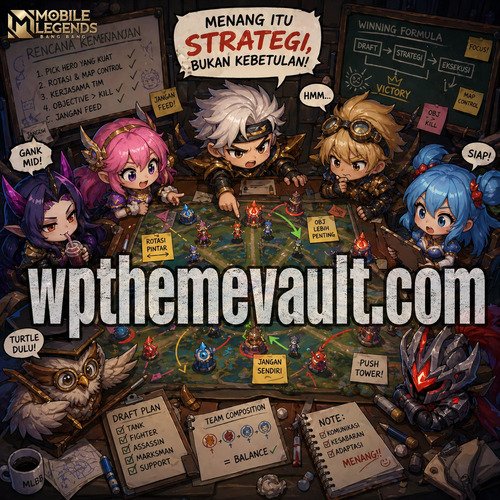
wpthemevault.com – Mobile Legends is often described as a fast-paced multiplayer game where players control heroes, destroy turrets, collect resources, and defeat opponents. However, mechanical skill is only one part of the experience. A player may understand abilities, combos, movement, and item functions, yet still struggle because the most important decisions during a match are made at the wrong moments. Knowing when to fight, when to farm, when to push, and when to retreat can completely change how a match develops. Good decision-making does not necessarily mean making complicated plays every minute. In many situations, the strongest choice is simply recognizing what the current game state demands and responding accordingly. A player who understands this principle can become more consistent because every movement has a purpose rather than being driven by habit or emotion.
Understanding the Situation Before Making a Move
The minimap provides information that should influence almost every important decision. Before moving toward another lane, entering the jungle, starting an objective, or looking for a fight, players should consider where teammates and opponents were last seen. The absence of an enemy does not automatically mean that the enemy has recalled. They may have rotated through the river, entered a bush, moved toward an objective, or prepared an ambush. This is why map awareness is more than simply looking at icons. It requires connecting several pieces of information together. If three opponents are visible on one side of the map, the remaining enemies may have limited options for where they can move. If several enemies disappear simultaneously, aggressive movement becomes more uncertain. These observations can determine whether pushing another lane is safe or whether waiting for additional information is better.
Information should also be considered together with the position of minion waves and turrets. A player may see an opportunity to attack an enemy hero, but if the next wave is approaching an exposed turret, abandoning that lane could create another problem. Likewise, a jungler may notice an opponent appearing on the opposite side of the map and immediately think about invading, but the decision depends on nearby allies, current health, available skills, and the position of surrounding lanes. Mobile Legends rewards players who think about several variables at the same time. Instead of asking only, “Can I fight this enemy?” it is more useful to ask, “What will happen across the map if I fight here?” That broader question helps players recognize whether a small engagement contributes to a larger advantage or simply creates unnecessary risk.
Comparing Resources, Cooldowns, and Power
Every hero enters a situation with a different level of combat readiness. Health, mana or energy, ultimate availability, battle spells, item progress, and level can all influence the outcome of an engagement. A player may have excellent positioning but still lose because their main abilities are unavailable. Conversely, an enemy may appear stronger but become vulnerable if important skills have already been used. Understanding these temporary conditions makes decision-making much more precise.
Gold and experience should also be viewed as resources that affect future decisions. A hero who has just completed an important item may have a different combat capability from the same hero several minutes earlier. A player approaching a major level milestone may choose to collect a nearby wave rather than immediately joining a low-value fight. The objective is not to avoid fighting whenever resources are incomplete. Instead, players should recognize the difference between a favorable fight and a fight that is being taken simply because enemies are visible. Strong decision-making means understanding why a fight is happening and whether the available resources support it.
This principle applies equally to the team as a whole. If several teammates have their ultimate abilities ready while opponents have recently used theirs, the situation may favor proactive movement. If the opposite is true, waiting can be more valuable. Cooldowns create temporary windows of opportunity, and recognizing these windows separates deliberate gameplay from automatic reactions. Even a short delay can allow a key ability to return, a teammate to arrive, or a minion wave to reach the desired position.
Recognizing the Difference Between Opportunity and Bait
Not every enemy mistake should be punished immediately. Sometimes an opponent appears isolated because they genuinely made a positioning error. In other situations, the apparent mistake is designed to attract players into an unfavorable location. This distinction becomes increasingly important as matches progress and the value of individual deaths becomes higher.
Before chasing a low-health opponent, players should consider what they cannot see. If the enemy disappears into a bush while teammates are missing from the minimap, continuing the chase may be dangerous. If an enemy retreats toward an area where several opponents could arrive quickly, the visible target may only be the beginning of the engagement. A controlled player does not allow the desire for a kill to override the larger situation.
This is particularly important for damage dealers and assassins, who can be tempted to pursue targets beyond safe positions. A kill is valuable, but dying immediately afterward can remove much of that advantage. The same concept applies to tanks and initiators. Starting a fight because an opponent is nearby does not guarantee that the rest of the team can follow. Good initiation requires consideration of distance, terrain, cooldowns, and teammate readiness. Sometimes the correct play is to wait several seconds rather than forcing the first opportunity that appears.
Choosing Between Farming, Fighting, Pushing, and Rotating
Farming is sometimes misunderstood as passive gameplay. In reality, efficient farming can create the resources needed for later pressure. The important question is whether farming is being done with a purpose. If a hero is close to completing a major item and there is no immediate objective requiring their presence, collecting a safe wave or jungle camp can improve future combat potential. However, farming becomes inefficient when players ignore important events happening elsewhere.
The best farming decisions usually account for timing and distance. A player can clear a wave and then rotate toward an objective rather than remaining in the same lane indefinitely. A jungler can collect camps while planning a route that places them near the next important area of the map. A gold laner can prioritize safe income while maintaining awareness of enemy movement. The goal is to gain resources without becoming disconnected from the team’s overall plan.
Players should also recognize dangerous farming locations. A wave may provide attractive gold, but if several enemies are missing and the lane is far from allied support, the potential reward may not justify the risk. Safe farming is generally more valuable than repeatedly dying while trying to collect every available resource. Losing a wave is temporary; giving the opponent a kill and surrendering map control can create a much larger problem.
Knowing When a Push Should Become a Rotation
Pushing a lane creates pressure because enemies must respond to minions and structures. However, remaining in a lane too long can cause a player to miss opportunities elsewhere. The key is recognizing when the current wave has accomplished its purpose.
After clearing a wave, players can examine the map before deciding what to do next. If an objective is approaching, rotating toward that area may be more valuable than immediately clearing another wave. If an enemy has recalled, a temporary numbers advantage may exist elsewhere. If a teammate is under pressure, a quick rotation could prevent a turret from being damaged or create an opportunity for a counterattack.
Rotations should also consider return paths. Moving across the map without thinking about the next wave can cause unnecessary resource loss. Efficient players often move with a sequence in mind: clear a wave, rotate, contribute to an objective or skirmish, then return to collect the next valuable resource. This creates a rhythm in which movement supports both immediate pressure and long-term development.
A common mistake is rotating simply because another teammate starts fighting. Not every fight requires every player to abandon their lane. If the engagement is already lost, arriving late may only add another death. If the fight is favorable and the player can arrive in time, however, joining can turn a small engagement into a major advantage. Timing matters more than simply moving quickly.
When Retreating Is Actually a Strong Decision
Retreating is often emotionally difficult because players may interpret it as giving up. In strategic gameplay, however, retreating can preserve resources and prevent a bad situation from becoming worse. A player who recognizes that an engagement has turned unfavorable and leaves early may remain available for the next objective, while a player who stays too long may die and lose even more control.
Several signals can indicate that retreating is appropriate. Multiple enemies may disappear from the map. Important defensive abilities may be unavailable. Teammates may be too far away to assist. A turret may be exposed without sufficient minion support. An objective may be impossible to contest safely. None of these situations automatically means that retreating is mandatory, but each should increase caution.
Good retreats are also proactive rather than purely reactive. Instead of waiting until health is critically low, players can leave when the expected value of remaining begins to decline. This allows them to reset, heal, purchase items, and return to the map with better resources. A controlled retreat can therefore be part of an aggressive strategy because it preserves the ability to make the next play.
Creating a Clear Purpose After Winning a Fight
Winning a teamfight is not necessarily the final objective. The advantage becomes meaningful when the team converts it into something permanent or strategically useful. After eliminating several opponents, players should quickly evaluate what is available: a turret, an objective, enemy jungle resources, a wave that can be pushed, or an opportunity to establish safer map control.
The correct conversion depends on the match state. If a major objective is available, the team may move toward it. If the objective is unavailable but enemy structures are vulnerable, pushing can be valuable. If waves are badly positioned, fixing them may be more useful than chasing another enemy. This prevents a common problem where players win a fight and then wander around without a clear goal.
The same principle applies after catching one isolated opponent. A single elimination may create a temporary numbers advantage, but the team must use the window efficiently. If the enemy’s strongest defender is gone, a turret may become vulnerable. If the enemy jungler is eliminated, an objective may become easier to secure. If a side-lane hero dies, pressure can be created on another part of the map. Good teams constantly translate temporary advantages into new positions of strength.
Adjusting Decisions When the Match Changes
A strategy that works in the early game may become inefficient later. As turrets fall, respawn timers increase, item levels rise, and the map becomes more dangerous, the consequences of mistakes become greater. Players therefore need to adjust their decision-making instead of repeating the same actions throughout the entire match.
A player who was previously comfortable taking short trades may need to become more cautious when enemy damage becomes significantly higher. A split-pushing strategy may require more information once opponents can eliminate a side-laner quickly. An aggressive invasion that worked earlier may become dangerous if the enemy has gained stronger area control. Adaptation is not about abandoning a plan after one mistake; it is about responding to changes in the conditions that made the plan effective.
Late-game decisions especially require patience. A single unnecessary death can create enough time for opponents to take an objective, destroy structures, or force a base defense. Because of this, players should value information and positioning more heavily. Waiting for teammates, clearing dangerous waves safely, and avoiding unnecessary chases can become just as important as mechanical execution.
Developing a Repeatable Decision-Making Habit
Improvement becomes easier when players stop judging decisions only by whether they produced a kill. A successful decision can be one that prevents a death, secures safe farm, protects a turret, forces an enemy recall, creates information, or positions the team for an upcoming objective. Looking at the result alone can hide the reasoning behind the decision.
After a match, players can think about several moments when they were uncertain. Why did they enter the fight? What information was available at the time? Which enemy abilities were missing? Were teammates close enough? Was there a safer way to gain resources? Could the same situation have been handled differently? These questions turn ordinary matches into practical learning opportunities.
Over time, this process develops recognition. Players begin to notice familiar situations before they fully develop. They recognize when an enemy rotation is likely, when a lane is unsafe, when a teammate needs assistance, and when a fight is unlikely to provide meaningful value. That recognition reduces hesitation while also reducing impulsive decisions. The result is gameplay that feels calmer because actions are based on the evolving state of the match rather than on constant reaction.
Conclusion Mobile Legends Decision-Making Guide: How to Know When to Fight, Farm, Push, or Retreat
Better decision-making in Mobile Legends comes from understanding that every action has an opportunity cost. Fighting means giving up some farming or positioning time, farming means temporarily reducing combat presence, pushing means committing attention to a lane, and retreating means accepting that a particular opportunity is no longer favorable. None of these choices is automatically correct in every situation. Their value depends on resources, map information, teammate positions, enemy movement, objectives, and the stage of the match. Players who learn to evaluate these factors can become more consistent without needing to force complicated plays.
The most useful habit is to pause mentally before important actions and ask what the team is trying to accomplish. If farming supports an upcoming power spike, farm efficiently. If a wave creates an opening for a rotation, use the opening. If an objective can be prepared safely, position early. If an engagement becomes unfavorable, preserve the ability to fight another time. Mobile Legends rewards players who understand timing and purpose, because the strongest decisions are often the ones that create several future options at once. With repeated practice, map awareness, resource management, positioning, and decision-making begin to work together, allowing each match to become a more deliberate and controlled experience.