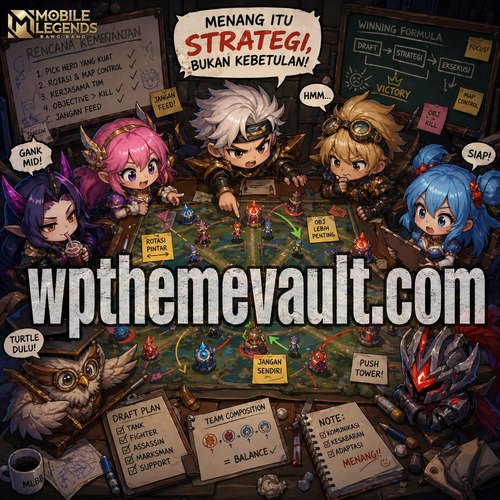
wpthemevault.com – In Mobile Legends, becoming the strongest player on your team can completely change the direction of a match. A hero with a significant gold advantage, strong items, high levels, or repeated successful plays can become the main source of pressure for the entire team. However, being the strongest player does not simply mean dealing the most damage or collecting the most kills. In many matches, the player with the biggest advantage becomes responsible for creating opportunities for teammates, controlling dangerous areas, and making sure the team’s lead does not disappear through unnecessary fights. A powerful hero can dominate several opponents at once, but that same confidence can become a weakness if the player starts taking every fight, entering areas without information, or chasing kills that provide little strategic value.
The strongest player should therefore think differently from an ordinary player. Instead of asking how to get even more personal resources, the better question is how to convert an individual advantage into a team advantage. A large gold lead has limited value if it remains trapped in one hero’s inventory. It becomes meaningful when that hero can use the advantage to force enemies away from objectives, protect teammates while they farm, create pressure across the map, or secure structures. This requires discipline because the strongest player often has more freedom than anyone else, but having more freedom does not mean every aggressive decision is correct.
Playing as the strongest member of the team also requires understanding the difference between being powerful and being invincible. Even a fed hero can be controlled, isolated, or eliminated if the enemy coordinates correctly. Losing the strongest player at the wrong moment can give the opposing team access to objectives, map space, and valuable time. The bigger the advantage, the more important it becomes to protect it. Strong players should therefore become more selective as their lead grows, not more reckless. The goal is to make the enemy feel pressured everywhere while giving them as few opportunities as possible to punish your mistakes.
Turning an Individual Lead Into Team Pressure
One of the most common mistakes made by strong players is continuing to farm as though they are still behind. Farming is useful, but there is a point where additional personal resources provide less value than using the existing advantage on the map. If a hero already has a meaningful item and level advantage, spending several additional minutes collecting every available camp and wave may allow the enemy team to recover elsewhere.
This does not mean a strong player should stop farming completely. Instead, farming should become connected to a purpose. Clear a wave before moving toward an objective. Take a nearby jungle resource while rotating to a threatened lane. Collect safe gold during a period when the enemy cannot contest you. The difference is that farming becomes part of movement rather than the entire reason for movement.
Imagine that your hero is significantly stronger than the opposing side laner. You could remain in your lane for another few minutes, repeatedly clearing waves and waiting for the enemy to approach. However, if your team is preparing for an important objective elsewhere, your advantage may have greater value when you leave the lane at the correct time and arrive first. The gold already collected has created the opportunity; continuing to farm is not necessarily the best way to use it.
Strong players should constantly ask whether another resource will actually change their next fight. If the answer is no, moving to create pressure may be more valuable. This is especially important during the mid and late game, when objectives, structures, and team positioning become increasingly important. A player who understands when enough farming has been achieved can turn a personal lead into map control much faster than someone who simply wants to increase the scoreboard numbers.
Become the Player Who Creates Space for Teammates
A strong hero does not always need to be the hero who gets the final kill. Sometimes the strongest player creates value simply by occupying a dangerous area and forcing enemies to respect their presence. When opponents know that approaching a certain lane or jungle area could result in losing a fight, they may be forced to move elsewhere. That movement creates space for your teammates.
For example, a strong fighter or durable hero can stand near a side lane and push the enemy back without necessarily committing to a kill. Meanwhile, teammates can collect resources or prepare another part of the map. The enemy has to decide whether to send several players to deal with the pressure or accept losing control of the area. Either choice can benefit your team if handled correctly.
This concept is especially powerful when your hero is difficult for the enemy to kill. Your objective is not always to dive into the enemy formation. Sometimes simply being visible in a threatening position is enough. The enemy may hesitate to advance because they know your team can arrive behind you.
The strongest player therefore acts as a source of space. Your presence should make your teammates’ jobs easier. A marksman should have more room to farm safely. A mage should have better access to positioning. A jungler should be able to approach an objective without being surrounded. A support should have more freedom to establish control. When your personal advantage improves the environment for the rest of the team, the lead becomes much harder for the enemy to recover from.
Share Pressure Without Giving Away Your Advantage
Being the strongest player does not mean taking every resource away from teammates. Once your hero has reached a comfortable power level, some resources can be more valuable when distributed to other teammates. This is particularly important when another hero on your team is close to completing an important item or reaching a useful power spike.
The goal is not to make your own hero weaker. The goal is to create several functional threats instead of one enormous threat. If the enemy only needs to focus on stopping you, your teammates can become easier to ignore. But if your team’s other damage dealer also becomes strong, the enemy has to divide defensive resources.
This does not mean blindly giving away every resource. A hero that requires consistent farm to maintain pressure should still receive appropriate resources. The important decision is recognizing diminishing returns. If taking one more wave gives you a small improvement while allowing another teammate to complete a major item, sharing may create a larger team advantage.
Strong players should therefore understand the difference between personal growth and team growth. The scoreboard may not immediately reward this decision, but the effect can become obvious during the next major fight. A teammate who receives the resources needed to reach their power spike can contribute far more than a teammate who remains weak because one already-fed hero collected everything.
Protecting the Lead Without Becoming Passive
When you are ahead, the enemy’s best chance to recover is often waiting for you to make a mistake. This makes fight selection extremely important. A strong player should not enter every encounter simply because they believe they can win it. Instead, fights should be connected to meaningful objectives or strategic advantages.
A fight near an important objective can be worth considerable risk because winning may provide resources that increase your team’s control. A fight that happens randomly in an empty area of the map may provide little even if you win. If you chase an enemy for thirty seconds and eventually secure a kill but lose a large minion wave, delay your rotation, and give the opponent’s teammates time to take another resource, the actual value of the kill may be surprisingly low.
Strong players should therefore ask what happens after the fight. If you win, what can your team take? Can you damage a turret? Can you secure an objective? Can you enter the enemy jungle? Can your teammates safely push another lane? If the answer is nothing meaningful, there may be no reason to risk the lead.
This does not mean playing passively. A strong player should still pressure the enemy, but the pressure should be purposeful. The difference between smart aggression and reckless aggression is usually what happens after the action. Good aggression produces additional advantages. Bad aggression produces isolated kills followed by unnecessary risk.
Avoid Becoming the Easiest Target on the Map
A fed hero naturally attracts attention. The enemy team understands that eliminating the strongest player can change the balance of the match. This means the strongest player should expect to be targeted and should position accordingly.
Walking alone into areas with no information can be extremely dangerous, even if your hero is significantly ahead. The enemy may not need to defeat you in a fair fight. They may simply need to combine crowd control, burst damage, or multiple heroes at the right moment. Once you are eliminated, your team may lose its strongest source of pressure at exactly the wrong time.
This is why strong players should use teammates and information more effectively. If you need to enter a dangerous area, consider whether another teammate can provide information first. If an enemy disappears from the map, do not assume they are retreating. If a major objective is approaching, avoid unnecessary deaths shortly before the contest.
Your advantage should make you more difficult to punish, not easier to target. The strongest player can often stand slightly farther forward than a weaker teammate, but that freedom should come from understanding the enemy’s location and capabilities. Confidence should be based on information, not simply on having more items.
Know When to Give Up a Small Advantage
One of the hardest lessons for strong players is learning to accept small losses. When you are ahead, you may feel that every enemy action must be stopped. That mindset can lead to unnecessary deaths. Sometimes the correct decision is to give up a turret, wave, jungle camp, or temporary area because contesting it would require too much risk.
Suppose the enemy has already established a strong position around one side of the map. Your team is outnumbered and your strongest player would need to walk through an uncertain area to contest a resource. Trying to defend it may feel necessary because your team is ahead. But if the enemy is specifically waiting for that response, the resource can become a trap.
A better approach may be to concede the small loss and take something elsewhere. Clear another lane, protect a different structure, collect safe resources, or prepare for the next objective. This preserves the advantage while limiting the enemy’s opportunity to create a comeback.
Being ahead does not mean winning every exchange. It means ensuring that the total direction of the match continues to favor your team. Strong players who understand this are much harder to punish because they do not allow pride to dictate their decisions.
Force the Enemy to Defend Multiple Problems
Once your hero is strong enough to threaten the enemy directly, the next goal is to create multiple problems at the same time. This can be achieved through side-lane pressure, controlled rotations, objective preparation, and coordinated movement. The enemy should be forced to decide which threat deserves attention rather than being given one obvious problem to solve.
A strong side laner, for example, can push a lane while teammates prepare pressure elsewhere. The enemy may need to send someone to respond, which creates a temporary numerical imbalance. Your team can then use that imbalance to move into another area. Alternatively, if the enemy sends several players toward you, your teammates can exploit the space they leave behind.
This does not require reckless split pushing. The principle is to make your strength affect more than one location. Your presence should influence enemy decisions even when you are not actively fighting.
The strongest player becomes particularly valuable when the enemy cannot predict where the next pressure will appear. If your team always groups in the same location, the opponent can prepare easily. But if your strength allows you to rotate between lanes while your teammates maintain pressure elsewhere, the enemy has to make more difficult decisions.
Use Objectives to Convert Strength Into a Permanent Lead
Kills are temporary. Objectives often create longer-lasting advantages. A strong player should therefore think about how each successful fight or rotation can lead to something that remains after the fight ends. Structures, enemy resources, map access, and major objectives can all create more permanent changes to the match.
If you secure a kill and then immediately return to farming, the enemy may recover quickly. If that kill allows your team to take a structure or control an important area, the advantage becomes more difficult to remove. This is why the strongest player should frequently direct attention toward what happens after successful engagements.
A powerful hero can make objective contests safer because the enemy must respect the hero’s damage or durability. Even without directly attacking the objective, the strongest player can create enough threat to prevent opponents from approaching. This allows teammates to complete the objective with less interference.
The key is to recognize when your strength is most useful. Sometimes your job is to attack the objective. Sometimes your job is to zone enemies away. Sometimes you should protect the teammate dealing the objective damage. Understanding these different functions prevents the strongest player from automatically chasing enemies when a more valuable task is available.
Finish the Match With Discipline
The final stage of a game often tests whether the strongest player can maintain discipline. Teams frequently throw winning positions because they become impatient after gaining a large lead. Players chase opponents too far, dive without enough information, or assume that one successful fight guarantees the next one.
The strongest player should instead become the stabilizing force. Maintain pressure, communicate useful information, respect enemy defensive abilities, and wait for the opportunity that makes the final push safer. If the enemy is trapped inside its base, there may be no reason to take a desperate fight. Continue creating pressure until the opponent is forced into an unfavorable decision.
This mindset can make the difference between a comfortable victory and an unnecessary comeback. A strong player should understand that the objective is not to prove how dominant the hero has become. The objective is to close the match while minimizing the enemy’s opportunities to recover.
Conclusion Mobile Legends Guide: How to Play as the Strongest Player on Your Team
Being the strongest player on a Mobile Legends team is both an advantage and a responsibility. A large gold or level lead gives you more influence over the map, but that influence only matters if it is converted into useful pressure. The strongest player should create space for teammates, choose meaningful fights, share resources when appropriate, and protect the advantage from unnecessary risks.
The biggest mistake is confusing strength with invincibility. Even a highly fed hero can be punished when isolated, surrounded, or caught without information. Playing from ahead therefore requires more discipline rather than less. Every movement should have a reason, every fight should offer meaningful value, and every major advantage should be converted into something that makes the enemy’s position harder to recover from.
The best strong player is not simply the one with the highest damage or most kills. It is the player whose advantage makes the entire team stronger. When personal power becomes map pressure, teammate freedom, objective control, and safer engagements, the enemy is forced into increasingly difficult decisions. That is how an individual lead becomes a team victory and how a strong performance can consistently translate into a controlled Mobile Legends win.