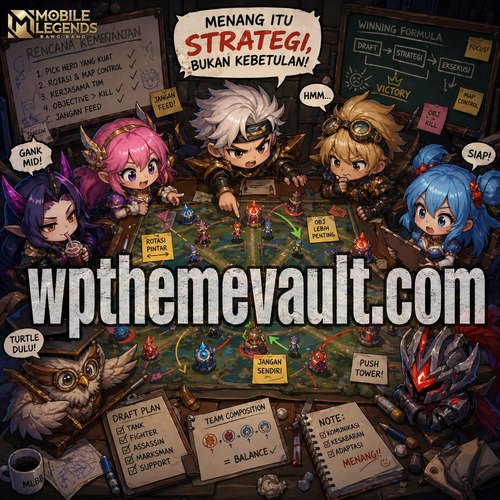
wpthemevault.com – Mobile Legends is a multiplayer battle arena game where mechanical ability is only one part of becoming a better player. A player can have excellent reflexes, fast fingers, and strong knowledge of a favorite hero, yet still struggle to win consistently if they do not understand how the battlefield works. Every match creates different situations because the heroes, team compositions, item choices, lane conditions, and decisions of both teams can change the flow of the game. This is why improving at Mobile Legends requires more than simply playing more matches. Players need to understand why certain decisions work, when to fight, when to farm, when to rotate, and how to turn small advantages into meaningful objectives.
Good gameplay begins with awareness. Instead of looking only at the hero directly in front of you, learn to observe the minimap, the position of teammates, missing enemies, minion waves, available objectives, and the amount of pressure being created around the map. These details provide information that can help you make better decisions before a fight even begins. A player who understands the situation several seconds earlier can often gain an advantage without needing superior mechanical skill. Likewise, knowing when not to fight can be just as valuable as knowing how to engage.
Understanding the Flow of a Mobile Legends Match
The opening minutes of a Mobile Legends match are important because they establish the conditions that influence the rest of the game. However, playing aggressively from the beginning does not automatically mean playing well. The early game should be approached with a clear purpose. Each player needs to collect resources, establish lane control, understand the enemy’s positioning, and prepare for upcoming objectives. Depending on the hero and role, the correct opening can be different. A marksman may prioritize safe gold collection, a jungler may focus on an efficient farming route, a roamer may provide vision and create opportunities, while an exp laner may need to balance experience farming with pressure on the opponent.
One common mistake is treating every early encounter as an opportunity for a kill. Players sometimes chase an enemy too far because they see the opponent’s health becoming low, only to lose their own position or become vulnerable to a rotation. A better approach is to ask what the fight will actually provide. If an enemy is forced away from a lane, your team may gain time to clear a wave, take a nearby resource, establish vision, or prepare for an objective. That can be more valuable than a risky pursuit. Early pressure should therefore be measured by the advantages it creates rather than simply by the number of eliminations.
Another important habit is paying attention to minion waves. A player who leaves a lane without considering the next wave may return to find their tower under pressure. Similarly, rotating at the wrong moment can cause unnecessary resource loss. Before moving across the map, consider whether the current wave is safe, whether a teammate can collect it, and whether the expected reward from the rotation justifies the time spent traveling. Efficient players constantly balance movement with resource collection.
The first few minutes are also a good opportunity to learn about the opposing team. Watch how the enemy jungler moves, identify which lanes are aggressive, notice which hero is being protected, and determine which opponents appear willing to overextend. These observations become useful later. Mobile Legends rewards players who collect information continuously because the information gathered early can influence decisions throughout the match.
Learn to Read the Minimap Instead of Playing Only Through Your Screen
The minimap is one of the most valuable sources of information in Mobile Legends, but many players only look at it when something obvious happens. Stronger gameplay requires more frequent observation. The minimap can reveal where teammates are located, which lanes are pushed, which enemy heroes have appeared, and which areas may be dangerous because opponents have disappeared from vision.
You do not need to stare at the minimap constantly. Instead, develop a habit of checking it whenever you finish an action. After clearing a wave, look at the map. After using an important skill, look at the map. Before entering the jungle, check the map. Before moving toward an objective, check the map again. This creates a rhythm where map awareness becomes automatic rather than something you remember only after being ambushed.
Missing enemies should also influence your decisions. If several opponents disappear simultaneously, assume they may be moving toward a teammate, an objective, or an area you are planning to enter. This does not mean you should panic every time an enemy leaves their lane. It means you should recognize that uncertainty itself is information. If you do not know where an opponent is, avoid making an unnecessarily vulnerable play until you have more information.
Map awareness also improves teamwork. Suppose your teammate is fighting near the top side while two enemies are visible elsewhere. Even without direct communication, you can recognize that the teammate may have a temporary numbers advantage. Conversely, if several enemies disappear while your teammate is pushing alone, you can anticipate the danger and respond before the fight starts.
Over time, good minimap habits change the way you experience the game. Instead of reacting to events after they happen, you begin predicting what might happen next. That difference is one of the foundations of strong macro gameplay.
Manage Resources With a Purpose
Gold, experience, health, mana, cooldowns, and map position are all resources. Players often focus heavily on gold while forgetting that other resources can determine whether a play succeeds. A hero with a completed item may still be ineffective if their ultimate is unavailable or their health is too low to participate safely.
Resource management begins with understanding your hero’s needs. Some heroes become much stronger after obtaining specific items or reaching certain levels, while others are effective earlier and can use that strength to create pressure. Your decisions should reflect these power timings. If your hero is waiting for an important item, unnecessary fights can delay the moment when you become stronger. If your hero is currently powerful, passive farming may waste an opportunity to pressure the enemy.
Health management is equally important. Returning to base at the correct moment can preserve your ability to contest the next objective. Staying in lane with very low health simply because you want one additional wave can become dangerous if enemies are missing. The same applies to battle spells and major abilities. A team with several important skills unavailable may need to play more carefully, even if they appear stronger on paper.
Good resource management is essentially about thinking ahead. Rather than asking only, “Can I fight now?” ask, “If I fight now, what will I have available for the next important situation?” This simple change in perspective can prevent many unnecessary deaths and improve your team’s ability to contest objectives.
Turning Individual Skill Into Teamwide Advantages
Mechanical skill is useful, but positioning determines whether those mechanics can be applied effectively. A player can execute a perfect combo and still lose a fight by entering from the wrong direction. Good positioning means staying close enough to contribute while remaining far enough away from unnecessary danger.
For marksmen and other damage-focused heroes, positioning is especially important. These heroes often become more powerful when they can attack continuously, but they are vulnerable when enemies reach them. Instead of standing at the front, look for safe angles where you can damage opponents without becoming the easiest target. Your position should also change as the fight develops. If an enemy assassin disappears, move more cautiously. If their main engage skill has already been used, you may have more freedom to step forward.
Tanks and roamers also need to understand positioning. Being the first hero to enter a fight does not mean staying there regardless of what happens. Sometimes the correct decision is to initiate and immediately create space for teammates. In other situations, the roamer may need to protect a vulnerable damage dealer instead of starting a fight. The best decision depends on the enemy composition and the position of both teams.
Positioning should also account for terrain. Bushes, walls, narrow paths, and jungle entrances can change the value of different heroes. Fighting in a location that benefits your hero can dramatically improve the outcome, while fighting in an area that gives the enemy easy access can create unnecessary problems.
The key lesson is that aggression should have structure. Do not move forward simply because an enemy is visible. Move forward because your team has the positioning, resources, and timing needed to support the action.
Know When to Take a Fight and When to Walk Away
Not every fight deserves to be taken. This is one of the most important lessons for players who want to become more consistent. A fight may look attractive because an enemy is nearby or because someone has made a mistake, but the surrounding conditions determine whether the opportunity is real.
Before committing, consider several factors naturally: how many teammates are nearby, how many enemies are visible, which major abilities are available, whether your team has sufficient health, and what objective can be gained afterward. If your team wins a fight but has no health left and cannot safely take anything, the reward may be limited. If the same fight occurs immediately before an important objective, the potential value can be much greater.
Walking away is not automatically a failure. Sometimes retreating preserves resources and prevents the enemy from gaining momentum. A player who survives a dangerous situation can return later with better equipment or stronger abilities. On the other hand, dying while trying to save an already-lost situation can turn one mistake into several problems.
One useful habit is recognizing the difference between an enemy being vulnerable and an enemy being isolated. A low-health opponent is not necessarily an easy target if their teammates are nearby. Likewise, a seemingly strong opponent may be vulnerable if they are separated from their team and lack important abilities.
Good decision-making means evaluating the entire situation rather than focusing on one health bar. The battlefield is larger than the immediate fight.
Convert Advantages Into Objectives
Kills are useful, but they are rarely the final purpose of a Mobile Legends match. The ultimate goal is to destroy the enemy base, and that usually requires converting temporary advantages into permanent map pressure.
After winning a fight, immediately consider what can be taken. A nearby tower, jungle resource, major objective, enemy buff, or pushed lane may provide more lasting value than chasing another opponent. If several enemies are dead, the enemy team has fewer players available to defend important areas. That creates a temporary window that should be used efficiently.
Tower pressure is particularly valuable because destroying structures reduces the enemy’s safe territory. As the map becomes more open, your team gains additional movement options and can invade areas that were previously protected. This can gradually make it harder for the opponent to farm safely.
Objectives also create strategic pressure. Even when an objective cannot be taken immediately, forcing the enemy to respond can open opportunities elsewhere. For example, showing pressure on one side may force opponents to move there, giving teammates space on another part of the map. This is why macro gameplay often involves creating choices for the enemy rather than simply searching for fights.
A strong player constantly asks, “What does this advantage allow us to do?” rather than stopping at “We got a kill.” This mindset helps transform individual successes into teamwide progress.
Improve Through Review Instead of Blaming the Match
Improvement becomes much faster when every match provides useful information. After a difficult game, it is easy to blame teammates, matchmaking, bad luck, or an opponent’s hero choice. Those factors may influence a match, but focusing only on them does not reveal what you can improve.
Instead, examine several moments from the game. Look at your first major death and ask what information was available before it happened. Consider whether you saw missing enemies, whether you entered without important skills, or whether you stayed in an unsafe area too long. Then examine your successful plays. Understanding why something worked is just as valuable as identifying mistakes.
You can also evaluate your movement. Did you spend too much time walking between lanes without collecting resources? Did you arrive late to important objectives? Did you leave a lane at the wrong moment? Did you continue farming while your team needed help elsewhere? These questions reveal macro problems that may not be obvious during the match itself.
Mechanical improvement should also be targeted rather than random. If you repeatedly miss a hero’s skill combination, practice that specific sequence. If your positioning causes frequent deaths, focus on staying behind appropriate teammates during fights. If you struggle with map awareness, deliberately create a habit of checking the minimap after major actions.
Progress in Mobile Legends rarely happens because a player suddenly becomes perfect. It usually comes from correcting small recurring mistakes until they become less frequent. Consistency develops when good decisions become habits.
Adapt Instead of Following One Strategy Every Game
There is no single strategy that works perfectly in every Mobile Legends match. A player may have a preferred hero, build, rotation pattern, or teamfight style, but opponents can force adjustments. Learning to adapt is therefore more useful than memorizing one rigid approach.
If the enemy has strong crowd control, positioning becomes more important. If they have powerful late-game heroes, allowing them unlimited farming may create problems. If your team has stronger early-game pressure, you may want to use that advantage to contest space before the opponents reach their preferred power timings. Conversely, if your team is weaker early, avoiding unnecessary fights and securing resources can keep the game manageable.
Adaptation also applies to itemization. Recommended builds can provide a useful starting point, but the enemy’s composition may require different defensive or offensive choices. Consider what is actually threatening you. If most incoming damage comes from physical sources, appropriate physical defense may provide greater value than blindly following a standard build. If enemy crowd control is repeatedly preventing you from dealing damage, surviving and maintaining uptime may be more important than adding another offensive item.
The same principle applies to rotations. A fixed rotation can become predictable. If the enemy repeatedly anticipates your movement, change your approach. Sometimes simply delaying your rotation can make an opponent reveal their position first.
Adaptation does not mean changing everything constantly. It means recognizing which part of your strategy is no longer producing the desired result and adjusting that part.
Communicate Through Actions and Simple Signals
Team communication in Mobile Legends does not always require lengthy messages. Quick signals, pings, movement, and positioning can communicate useful information. When several teammates move toward the same objective, the intention becomes clear. When a roamer retreats and signals danger, teammates can recognize that continuing forward may be risky.
Players should also understand that communication is most effective when it provides actionable information. A warning about an enemy’s missing position is more useful than a message criticizing someone for dying. During a tense match, unnecessary arguments consume attention without improving the battlefield situation.
If a teammate makes a mistake, focus on what needs to happen next. If an objective is approaching, prepare for it. If a lane needs to be cleared, communicate that through movement or a quick signal. The goal of communication should be coordination, not proving who was responsible for a previous mistake.
Strong teamwork often looks simple from the outside. Players move together when necessary, spread across the map when appropriate, protect important teammates, and respond quickly to changing situations. Those actions come from shared awareness rather than constant conversation.
Develop Patience During the Late Game
Late-game Mobile Legends matches can change quickly because heroes have more damage, more items, and less room for mistakes. A single unnecessary death can leave a team unable to defend its base or contest a major objective. For this reason, patience becomes increasingly valuable as the match progresses.
Late-game players should avoid walking alone into uncertain areas without a clear reason. Vision becomes more important because enemies can hide and create sudden engagements. Before entering a jungle area, consider whether your teammates are close enough to respond. Before pushing a lane, check whether important enemies are visible.
Another important habit is waiting for the correct moment. Sometimes the enemy will make a mistake by overextending or using an important ability too early. Instead of immediately rushing forward, wait for the opportunity to become clearer. A patient team can punish an opponent who becomes impatient.
Late-game wave management also deserves attention. Even if your team has a strong advantage, ignoring side lanes can create pressure on your own base. Before committing everyone to one area, make sure dangerous waves are handled or that the team understands the trade-off.
The final stages of a match are not about playing faster simply because the game is almost over. They are about making fewer unnecessary mistakes while using every advantage efficiently. When the enemy has limited opportunities to recover, controlled pressure can be more effective than reckless aggression.
Conclusion Mobile Legends Strategy Guide: How to Improve Your Gameplay, Make Better Decisions, and Win More Matches
Improving at Mobile Legends is a process of developing better habits rather than simply searching for more powerful heroes or complicated mechanics. Strong gameplay comes from understanding the relationship between resources, positioning, map information, objectives, timing, and teamwork. A player who consistently checks the minimap, manages waves, recognizes power timings, evaluates fights carefully, and converts advantages into objectives will gradually gain a deeper understanding of the game.
The most important improvement is learning to think beyond the immediate action. A kill matters because of what it allows your team to do afterward. A rotation matters because of the pressure it creates. Retreating matters because it preserves resources and prevents unnecessary losses. Farming matters because it prepares a hero for future power spikes. Even a simple movement across the map can have strategic value when it changes the options available to both teams.
Mobile Legends becomes much easier to understand when each match is treated as a sequence of decisions rather than a collection of random fights. Focus on making useful decisions repeatedly, learn from situations that go wrong, and adapt your approach according to the battlefield. With enough practice, mechanical skill and strategic awareness begin to work together, allowing you to play with greater confidence, consistency, and control from the opening minutes until the final push.