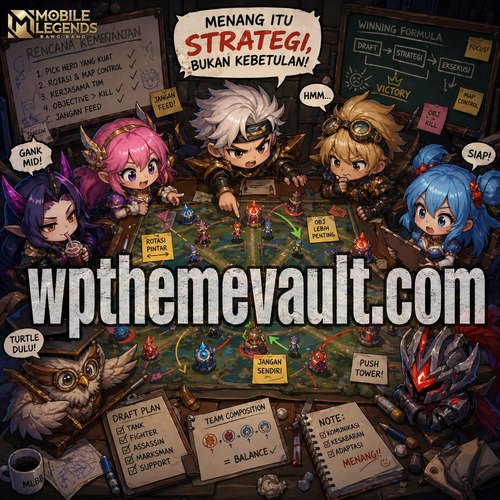
wpthemevault.com – Mobile Legends: Bang Bang is often described as a team-based battle arena where players choose heroes, destroy enemy structures, and work together to reach the opposing base. However, understanding the basic objective is only the beginning. As players gain experience, they discover that many matches are decided by something less obvious: tempo. Tempo refers to which team is currently able to act first, create pressure, collect resources, or force the opponent to respond. A team does not necessarily need to win every fight to control the tempo of a match. Sometimes clearing a wave quickly, forcing an enemy to return to base, taking control of an important area, or making an opponent waste a major ability can create enough time for another teammate to gain an advantage somewhere else. This is why learning how to play Mobile Legends effectively requires more than mechanical skill. Players need to understand the relationship between time, resources, positioning, and risk. Gold and experience create stronger heroes, but those resources only become useful when they are converted into meaningful actions. A team with a small economic lead can still lose if it repeatedly takes poor fights, while a team that is behind can sometimes recover by avoiding unnecessary engagements and taking efficient trades. Good gameplay is therefore built around decisions rather than constant action. Players need to recognize when to accelerate the game and when to slow it down. They need to know when an advantage is real and when it is only temporary. They also need to understand that every action has an opportunity cost. Spending time chasing an enemy means giving up time that could have been used to farm. Rotating toward one objective may mean leaving another area temporarily vulnerable. Defending a structure may prevent a player from collecting resources elsewhere. None of these decisions are automatically correct or incorrect. Their value depends on the current match situation. By learning to evaluate these trade-offs, players can develop a stronger sense of game flow and become more consistent in both winning positions and difficult matches.
Learning How Tempo Shapes the Match
Tempo is one of the most useful concepts for understanding why certain teams always seem to move first. When a team has tempo, it usually has enough freedom to decide what happens next. Its players can clear waves, rotate, establish vision, pressure a lane, prepare for an objective, or force the enemy to react. The opposing team, meanwhile, may spend its time answering those actions instead of creating its own opportunities. This does not mean that every action must be aggressive. Defensive actions can also create tempo when they prevent the enemy from gaining something important. For example, quickly clearing a dangerous minion wave can prevent the enemy from applying pressure to a structure and give teammates time to reposition. A player can also create tempo by pushing an enemy out of a lane, because the opponent then has to spend time recovering health or returning to the battlefield. The important point is that time has value. When one team spends thirty seconds accomplishing something useful while the other team spends those same thirty seconds responding, the first team may gain additional opportunities. This can lead to a chain of advantages. A cleared wave allows a rotation, the rotation creates pressure, pressure forces an enemy to retreat, and that retreat creates space around an objective. Players should therefore stop thinking about individual actions as isolated events. Every movement can influence what becomes possible afterward. Learning tempo also helps players understand why some fights feel successful even when nobody is eliminated. If a team forces several opponents away from an objective and gains control of the surrounding area, it may have achieved something valuable without producing a kill. Similarly, a player who survives an aggressive enemy attempt and forces the opponent to retreat may have protected resources and maintained lane control. Strong players learn to recognize these invisible gains. They understand that controlling the rhythm of the match can be just as important as winning direct confrontations.
Knowing When to Speed Up or Slow Down
One of the most important strategic decisions is determining whether the current situation favors faster or slower gameplay. When a team has a clear advantage, speeding up the match can sometimes make sense because the opposing team has fewer resources and less freedom to respond. However, rushing every opportunity can also throw away an advantage. If players become too aggressive, they may enter areas without sufficient information or fight before teammates are ready. Slowing the game can be equally valuable. A team that is waiting for an important item, ultimate, or respawn may benefit from avoiding unnecessary battles until its strength improves. Players should learn to identify these moments instead of automatically following the same rhythm throughout the entire match. Hero composition also influences tempo. Some teams benefit from early pressure, while others become significantly stronger after obtaining several items. If a team has strong early-game capabilities, it may want to create pressure before the opponent reaches its preferred power point. If the team scales better, it may prioritize safe resource collection and minimize unnecessary losses. Players should also consider the state of the map. A team that has pushed several waves and controls important routes can often act more aggressively because it has better information and more space. A team with exposed lanes and missing structures may need to slow down and rebuild control. The key is to connect the current tempo with the team’s actual strengths. Players should ask whether accelerating the game creates more opportunities than risks. They should also ask whether slowing down gives the opponent time to recover. This kind of thinking makes gameplay more deliberate. Instead of fighting simply because an enemy is nearby, players begin choosing actions based on how those actions affect the next several minutes of the match.
Creating Pressure Without Constant Fighting
Pressure is often misunderstood as continuous combat, but effective pressure can come from many different actions. A player who consistently clears a side lane can force an opponent to respond even without fighting. A jungler who appears briefly in several areas can make enemies uncertain about where the next attack will occur. A team that controls a key route can make the enemy spend more time moving around dangerous areas. These actions create pressure because they restrict the opponent’s choices. Players should learn to recognize the difference between activity and productive pressure. Running around the map without accomplishing anything may look active but can actually waste resources. In contrast, one carefully timed movement can force an enemy to abandon a wave or delay an objective. Good pressure is therefore connected to purpose. Before moving somewhere, players should understand what they want the enemy to do. If the goal is to protect a teammate, the player can position nearby without necessarily initiating a fight. If the goal is to create space for an objective, pushing a distant lane may force an opponent to leave the objective area. If the goal is to defend, simply showing presence may discourage an enemy from committing. This style of gameplay rewards patience because players do not need to reveal their full intentions immediately. The threat of action can sometimes be enough. When opponents are uncertain, they may make defensive decisions that cost them resources. Over time, these small pressures can accumulate into a meaningful advantage. Players who master this approach become less dependent on kills because they can influence the map through positioning, wave management, and timing.
Managing Resources and Making Better Trades
Mobile Legends contains several resources that players constantly exchange, including gold, experience, health, cooldowns, time, and map position. Strong decision-making comes from understanding that spending one resource may affect another. A player who spends a long time chasing an enemy may gain a kill but lose valuable farming time. A team that uses several major abilities to eliminate one opponent may be vulnerable during the next objective. A player who sacrifices health to clear a wave may gain resources but become unable to participate in an upcoming fight. These situations cannot be judged only by looking at the immediate result. Players need to consider what they gain and what they give up. This is the foundation of resource trading. A trade does not need to be perfect to be useful, but it should generally provide enough value to justify the cost. For example, using an important ability to secure a major objective may be reasonable because the objective can influence the entire team. Using the same ability simply to damage an enemy who can safely retreat may produce less value. Players should also think about time. Time spent traveling is not automatically wasted, but unnecessary travel can delay farming and objective preparation. The same applies to recalls. Returning to base at the right moment can restore health and allow a player to purchase an important item, but recalling immediately after arriving in a lane may cause unnecessary resource loss. Better players develop a sense of these exchanges naturally. They begin recognizing when an action is efficient and when it creates hidden costs. This understanding also helps when playing from behind. A losing team cannot always compete directly for every resource, so it needs to find trades that remain favorable. Giving up a small objective while taking resources elsewhere may be better than forcing a fight that could result in multiple deaths. Resource management turns Mobile Legends from a sequence of battles into a continuous process of choosing what the team is willing to exchange.
Trading Objectives and Map Space
Not every objective can be contested safely, and not every area of the map has equal value at every moment. This means teams sometimes need to trade one resource for another. If the enemy commits several heroes to one side of the map, teammates may have an opportunity to take resources on the opposite side. The important part is recognizing the situation quickly. Players should not continue moving toward an objective that has become extremely difficult to contest simply because it was the original plan. A flexible team can change its decision when new information appears. This does not mean abandoning objectives carelessly. It means understanding that map space itself has value. If the enemy takes control of one area, the team may be able to gain something elsewhere. Side-lane pressure can become especially useful in these situations because it forces opponents to make choices. An enemy team may want to group around an objective, but if a side lane is pushing toward a structure, someone may need to respond. That creates a trade-off. Players can use these moments to create pressure without directly fighting. However, the value of the trade depends on timing. Taking a small amount of farm while losing a major structure may not be worthwhile. Conversely, allowing the enemy to secure one resource while taking several structures elsewhere may produce a meaningful advantage. Players should therefore compare outcomes rather than focusing on individual events. A team does not need to win every exchange. It needs to avoid exchanges where the cost is significantly larger than the benefit. This mindset is particularly important for players who become frustrated when they cannot contest everything. Sometimes the correct response to an enemy advantage is not immediate confrontation but controlled compensation. The team can collect resources, push another lane, reset its positioning, and prepare for the next opportunity.
Recognizing When a Trade Is No Longer Worth It
Players often become committed to a decision simply because they have already invested time in it. This can lead to poor outcomes. A team may begin chasing an enemy and continue long after the enemy has reached safety. Players may move toward an objective and continue even after several teammates have been eliminated. These situations demonstrate why reassessment is important. A decision that was reasonable thirty seconds ago may no longer be reasonable now. The battlefield changes constantly. Enemy positions change, abilities become available, health levels decrease, and minion waves move. Players should therefore evaluate situations repeatedly rather than treating their original plan as permanent. One useful question is whether the expected reward is still available. If an enemy has escaped and there is no realistic way to catch them, continuing the chase may only create risk. If an objective is already secured by the enemy, attempting to fight afterward may be less valuable than protecting structures or collecting resources elsewhere. If a teammate has been eliminated before a planned engagement, the team may need to cancel the fight entirely. This flexibility separates strategic gameplay from automatic gameplay. Players should be comfortable abandoning an action when the circumstances change. Doing so is not necessarily a failure. It can be a sign of good awareness. The goal is not to prove that the original decision was correct. The goal is to maximize the current opportunity. Over time, players who practice this mindset become better at minimizing losses. They stop turning small mistakes into larger ones simply because they feel committed to an earlier plan. This is particularly valuable in difficult matches, where the difference between a manageable disadvantage and a catastrophic one can be a single unnecessary decision.
Protecting an Advantage Instead of Becoming Overconfident
Once a team gains an advantage, the next challenge is preserving it. This sounds simple, but leading teams often become less disciplined because they feel stronger. Players may begin taking isolated fights, entering unknown areas, or chasing enemies too far. A gold advantage does not make a hero immune to crowd control or poor positioning. In fact, the larger the lead becomes, the more important it can be to protect it. Players should continue farming efficiently, maintain map awareness, and avoid unnecessary risks. The objective is to increase the opponent’s problems while reducing opportunities for recovery. This may involve controlling waves, protecting important structures, and preparing objectives before they appear. Teams should also communicate when they need to reset. After winning a fight, returning to base to restore health and purchase items can sometimes be more valuable than immediately looking for another engagement. The team can then return to the battlefield with stronger resources and better positioning. Maintaining momentum does not mean moving constantly. It means making sure the enemy has fewer opportunities to regain control. Players should also recognize that different heroes have different responsibilities while ahead. A frontliner may need to establish space, while damage dealers should preserve safe positioning. A side-lane player may create pressure away from the main group, but should not become so isolated that the enemy can eliminate them easily. Every player contributes to protecting the advantage. When a team understands this, its lead becomes more stable. Instead of relying on repeated risky fights, it gradually restricts the opponent’s available options until the path toward victory becomes clearer.
Recovering When the Team Falls Behind
A strong Mobile Legends player also needs to understand how to play when things go wrong. Falling behind does not automatically mean the match is lost, but it does require different decisions. The team should avoid trying to imitate the behavior of a team that is already ahead. If the opponent has stronger equipment and better map control, direct fights may be unfavorable. The losing team can instead focus on safe farming, wave management, defensive positioning, and opportunities created by enemy mistakes. Players should identify which resources are still accessible. A side lane may provide farm when the central area is too dangerous. A defensive structure can provide a safer location for clearing waves. An enemy overextension may create an opportunity to eliminate an isolated hero. The key is to avoid making the disadvantage larger. A team that loses one fight and then immediately forces another may create a much bigger problem. A team that loses one fight and instead resets, clears waves, and waits for a better opportunity can sometimes stabilize. Recovery is also about psychology and communication. Players should avoid turning a disadvantage into blame because arguments rarely improve map control. Clear communication about where enemies are located and what resources are available is more useful. The team should look for achievable objectives rather than attempting to recover everything at once. One successful defensive play can create enough space to collect resources. Those resources can lead to stronger equipment, which creates better team-fight opportunities. A comeback often happens through a sequence of small improvements rather than one miraculous play. Players who understand this remain calmer when behind and become more capable of taking advantage of enemy mistakes.
Knowing When to Commit to the Final Push
The final stage of a Mobile Legends match requires players to distinguish between having an advantage and having a safe opportunity to end the game. A team may win a fight but still need to consider minion waves, remaining enemies, health, and available abilities before committing to structures. The goal is to use the advantage efficiently without allowing defenders to create a counterattack. Players should pay attention to which enemy heroes are still alive and where they can approach from. If the remaining defenders have strong wave-clearing abilities, the team may need to manage minions carefully before making a final push. If the enemy’s main defensive tools are unavailable, the team may have a larger window. Timing matters because the final push should be based on the actual battlefield rather than excitement after a successful fight. Players should also resist unnecessary chasing. If an enemy retreats away from the base, following them may waste the limited time available to damage structures. The team should stay focused on what can actually end the match. Positioning remains important even during the final attack. Players should not all stand in the same location if that makes them vulnerable to area damage, and damage dealers should maintain enough distance to continue contributing. If the first attempt is stopped, the team should not immediately repeat the same attack. Resetting, rebuilding waves, and creating pressure from another direction can produce a better opportunity. Closing a match is therefore another form of decision-making. The team needs to recognize when the conditions are favorable, commit together, and remain focused on the main objective. A controlled ending is usually the result of many earlier decisions rather than one final moment. When players understand tempo, resource management, risk, and momentum, they can approach the final stage with greater clarity and reduce the chances of throwing away a hard-earned lead.
Conclusion Mobile Legends Strategy Guide: How to Control Tempo, Resources, and Momentum
Improving at Mobile Legends is not only about mastering hero mechanics or learning which abilities to use during a fight. A deeper understanding comes from recognizing how tempo, resources, risk, and momentum interact throughout the match. Tempo determines which team has the freedom to make the next move, while resource management determines whether those movements can actually create meaningful advantages. Players who understand these concepts begin to see value in actions that might initially appear small, such as clearing a wave before rotating, forcing an opponent to retreat, protecting an important cooldown, or trading one area of the map for another. They also become more comfortable changing plans when the situation changes. This flexibility is essential because no match develops exactly as expected. A successful strategy may need to be adjusted after an unexpected death, a missed objective, an enemy rotation, or a sudden change in map pressure. Players should therefore avoid treating Mobile Legends as a game where every situation has one fixed answer. Instead, they should learn to compare available options and choose the action that provides the most useful outcome under the circumstances. When ahead, the priority is to protect the advantage and gradually reduce the opponent’s opportunities to recover. When behind, the priority becomes minimizing losses, collecting safe resources, and waiting for realistic openings. During the final stages, the team must convert its accumulated advantages into structures and eventually the enemy base without becoming distracted by unnecessary fights. With practice, this way of thinking can make gameplay more consistent. Players begin to understand not only what they are doing, but why they are doing it and what the action is supposed to create next. That deeper awareness can improve decision-making across every phase of Mobile Legends and make each match feel more controlled, purposeful, and strategically connected.