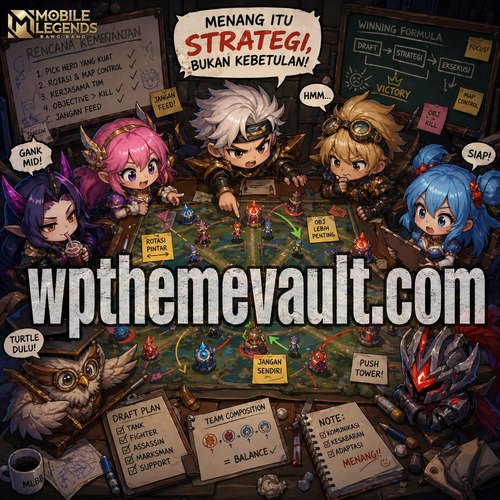
wpthemevault.com – The transition from the early laning phase into the mid game is one of the most important periods in Mobile Legends. During the opening minutes, players usually have clear responsibilities. Gold Laners focus on developing their economy, EXP Laners manage their lanes, Mid Laners clear waves and rotate, Junglers collect resources while preparing objectives, and Roamers create opportunities around the map. As the match develops, however, those responsibilities become less rigid. Players must begin responding to a changing battlefield instead of simply returning to the same lane after every wave.
This transition can be difficult because the map begins to open up. Turrets may fall, heroes acquire more equipment, and fights become more frequent. A player who continues following an early-game routine without adapting may waste opportunities or expose the team to unnecessary pressure. The correct question is no longer simply where a player should farm. It becomes a broader question of how available resources, structures, objectives, and hero strengths should be connected.
Mid game also introduces greater importance to movement. A player may need to leave their original lane to defend another structure, join an objective contest, clear a dangerous wave, or support a teammate who has gained an advantage. At the same time, leaving a lane without a reason can cause unnecessary resource losses. Good transitions depend on identifying which part of the map deserves attention at each moment.
The most effective way to understand this phase is to think of the map as a collection of priorities. Not every turret, wave, jungle camp, or enemy hero has equal value. Players who can identify the most important resource or threat at the right time will usually make more meaningful decisions than players who simply move toward the nearest fight.
Understanding the Transition From Laning to Mid Game
Early laning usually gives players a predictable routine. Clear the wave, collect resources, watch the enemy, and prepare for the next wave. Once the first major structures begin to fall, that routine becomes less reliable.
A player may finish their laning assignment and discover that the original turret is no longer the safest or most valuable place to spend time. Continuing to stand there can expose them to unnecessary pressure while teammates elsewhere may need assistance.
This does not mean players should abandon farming. Instead, farming becomes more flexible. A Gold Laner may continue collecting waves while moving toward safer areas. A Mid Laner may clear a wave and immediately help control another part of the map. An EXP Laner may become more involved in side pressure or team fights.
The key is recognizing that the purpose of a lane changes after structures fall. A lane is no longer only a place to farm. It becomes a tool for creating pressure and controlling where the enemy can move.
Players should therefore observe the condition of all lanes rather than focusing exclusively on their original position. If one lane is pushing toward the enemy side while another is collapsing toward an allied structure, the team may need to redistribute its attention.
Good transitions happen when players gradually move from fixed responsibilities toward flexible map priorities.
Understanding Which Turret Matters Most
Not every turret has the same strategic value at every moment. Players sometimes see a low-health structure and immediately move toward it, but the surrounding situation may make another objective more important.
A turret can be valuable because it protects a farming area, limits enemy movement, or provides defensive safety. Losing a structure may also expose a jungle entrance and make future rotations more dangerous.
Before committing to a turret push, players should consider whether enough teammates can support the action. A damaged turret does not automatically represent a free objective if the enemy can arrive first.
Likewise, defending a turret may not always require several heroes. If the structure is already impossible to save and multiple enemies are committing to it, the team may gain more value by taking resources elsewhere.
The mid game is therefore about exchanging pressure intelligently. Teams rarely control every part of the map simultaneously. The goal is to recognize which structures and areas should receive immediate attention.
Players who understand turret value can make better decisions about when to defend, when to push, and when to trade pressure across the map.
Moving Away From a Single-Lane Mindset
A common mid-game mistake is remaining attached to the lane a player started in. Once the map opens, this can cause inefficient rotations and make the player predictable.
Players should instead think about their role in the team’s overall economy and pressure. A hero may temporarily leave their normal lane because another wave is more important, an objective is approaching, or a teammate needs protection.
This does not mean everyone should constantly group. Excessive grouping can cause several heroes to share the same resources while other lanes remain unattended.
The ideal approach is flexible distribution. Players should know when to group and when to spread across the map.
For example, several teammates may gather around an objective while another player safely handles a distant wave. After the objective is resolved, the team can redistribute again.
This constant movement between grouping and spreading is one of the defining characteristics of mid-game gameplay.
Converting Small Advantages Into Map Control
Winning a team fight does not automatically mean the team has gained a meaningful advantage. The value comes from what happens immediately afterward.
A successful fight may create an opportunity to take a turret, secure an objective, invade the enemy jungle, collect waves, or establish safer vision. Players should quickly identify which resource can be obtained while the enemy is unable to respond.
One of the most common inefficiencies is chasing opponents too far after the fight has already been won. A surviving enemy with low health may be less valuable than a nearby turret or objective.
Players should therefore ask what the team can gain from the enemy’s absence. If several opponents are dead or forced to recall, the map temporarily contains fewer threats. That window should be converted into something concrete.
This principle applies even when only one or two enemies are eliminated. A small numerical advantage can make a nearby objective or structure safer to contest.
The goal is to turn combat into map progress rather than treating kills as the final objective.
Using Lane Pressure Before Taking Objectives
Objectives become easier to control when nearby lanes are managed first. A team that starts an objective while its lanes are collapsing may create unnecessary problems.
Clearing or pushing a lane before an objective can force opponents to choose between defending their structures and moving toward the contest. This creates pressure before the actual fight begins.
The timing must be coordinated carefully. If a player pushes too deeply and arrives late to the objective, the pressure may become counterproductive. The purpose of the lane movement is not simply to push as far as possible. It is to create a favorable timing window.
Players should therefore consider how long it takes to clear the wave, move toward the objective, and arrive in a useful position.
This relationship between lanes and objectives is one of the most important mid-game concepts. Objectives are rarely isolated events. They are influenced by what happens in the surrounding lanes before the contest starts.
Using Enemy Absences to Gain Resources
When enemies reveal themselves on one side of the map, the opposite side can temporarily become more accessible.
A player does not always need to fight the enemy to gain an advantage. They may instead take a jungle camp, push a wave, damage a turret, or establish safer positioning elsewhere.
This becomes especially important when the enemy team commits multiple heroes to one area. Their concentration creates opportunities on another part of the map.
However, players should avoid assuming that every visible enemy is permanently trapped in one location. Movement speed, mobility skills, and recall timing can allow opponents to respond quickly.
The safest approach is to use confirmed information while continuously checking whether the situation has changed.
Good macro play often comes from these small exchanges. The team may not win a dramatic fight, but repeatedly taking resources whenever the enemy is occupied can gradually create a significant advantage.
Identifying Which Hero Should Receive Space
As the match progresses, different heroes become important for different reasons. One may have excellent scaling, another may possess strong initiation, and another may have the ability to pressure side lanes.
Teams can become more effective when players recognize where their current strength lies.
If a damage dealer has accumulated strong equipment, teammates may need to provide space and protection so that the hero can operate safely. If a frontline hero is strong enough to initiate, the team may benefit from playing closer together around that strength.
This does not mean every match should revolve around the same role. The correct focus depends on actual game conditions.
Players should consider levels, equipment, recent fights, and positioning rather than relying only on hero labels.
The goal is to maximize the team’s existing strengths while reducing exposure to its weaknesses.
Avoiding Unnecessary Grouping
Grouping creates safety and combat power, but too much grouping can reduce the team’s overall resource income.
If five players stand in one lane without a clear objective, they may divide experience and gold while allowing enemy side lanes to develop.
Mid game requires controlled grouping. Players should gather when there is a meaningful reason, such as contesting an objective, attacking a structure, responding to a threat, or forcing the enemy to react.
Once the immediate purpose is completed, players should redistribute instead of remaining together automatically.
This keeps the team productive and prevents wasted time.
Strong teams can appear coordinated even when they are spread across the map because every player understands what the group is trying to accomplish.
Protecting the Team’s Advantage
A small lead can disappear quickly if players become too aggressive. After gaining control, some teams begin chasing every enemy and entering deeper territory without sufficient information.
A better approach is to increase pressure gradually. Take safe resources, establish stronger map positions, and force opponents to respond.
Players should also recognize that having more gold does not make them invulnerable. Enemy crowd control, burst damage, and positional mistakes can still turn a fight.
Protecting an advantage means reducing unnecessary risks while continuing to create useful pressure.
This is particularly important in mid game because the map is still open enough for one mistake to create a major swing.
Conclusion Mobile Legends Mid Game Guide: How to Transition From Lanes Into Stronger Map Control
The transition into mid game changes the way Mobile Legends should be played. Fixed laning responsibilities gradually become flexible map priorities, and players need to understand when to leave their original lane, when to group, and when to spread across the map.
Turrets become more than structures that simply need to be destroyed or defended. Their locations influence farming safety, jungle access, and movement. Players who understand these relationships can make better decisions about where to apply pressure.
Small advantages should also be converted into concrete resources. A successful fight can create an opportunity for a turret, objective, jungle resources, or stronger map positioning. The important part is recognizing that kills are a means of creating pressure rather than the final goal.
Lane management plays a major role in this process. Pushing or clearing a lane before an objective can influence enemy choices and make the upcoming contest easier to control. Similarly, enemy positions can create opportunities to take resources elsewhere without directly engaging.
Finally, mid-game success depends on recognizing team strengths while avoiding unnecessary grouping. Players should gather when there is a clear purpose and redistribute when the purpose is complete. Protecting an advantage requires discipline as much as aggression.
When players learn to transition naturally from laning into flexible map control, the mid game becomes less chaotic. Instead of reacting to every fight or wave independently, they begin connecting structures, resources, rotations, and objectives into one larger plan. That understanding can make the entire match feel more deliberate and give every movement a clearer purpose.